Black History Hero: DeNorval Unthank

DeNorval Unthank, MD

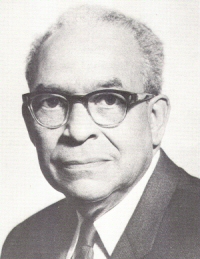
In third grade at Alameda Elementary School in Portland, one of my friends was Gregory Unthank. Gregory’s grandfather was one of the best known names in Portland’s African American community. Dr. Unthank was one of those local heroes who persevered and served tirelessly through times of hostility and bigotry. Their sacrifices and courage made all the difference in the historic struggle for civil rights and justice.

You can read biographical sketches of Dr. Unthank here and here.

“A Negro may have a few more doors closed to him and he may find them a little harder to open, but he can open them.  He must keep trying.”
Dr. DeNorval Unthank, 1899-1977


Indian Bracelet

“I’m going to Wounded Knee.”

At 9 years old, I was standing in our kitchen with my now divorced parents when Dad told Mom he was going to assist the Native American activists who had seized control of the South Dakota town and were surrounded by heavily armed US Marshals and FBI agents.

“We’re going to try to get some food in.”

My mom was plainly not enthusiastic about the idea of Dad entering a siege that threatened to explode into open warfare at any time, but she chose not to argue with him about it. He had made up his mind.

“Well, be careful. Don’t get yourself shot.”

It was commonplace when I was growing up that adults, especially young adults, had no idea what was so often was falling upon the ears of children. I know from my own experience as a parent that it is easy to forget that children are completely unable to take in certain words or conversations without utter bewilderment or fear.

Shot? I thought to myself. “Where are you going, Dad?”

“South Dakota. I should be back in about a week.”


Dad didn’t just look at the siege on the evening news one night and decide to go help. He had been deeply involved with the Indian community, particularly the Sioux, for some years. He worked at a social service agency in Portland called the Urban Indian Bureau. His close ties to the community had made him almost an honorary member. He made ceremonial drums and gave or traded them to his Indian friends.

Frank in 1976

One such friend was Frank White Buffalo Man, the last surviving grandson of the famous Sitting Bull. For one drum Dad made, Frank traded a wonderful oil-on-canvas he had painted of a bald eagle in flight, which still hangs in Dad’s house. Dad’s friendship with Frank also rendered another honor. Dad presented each of his children to Frank to receive a Siouan name. I went with Dad to meet him, and Frank White Buffalo Man named me Hoksila (pronounced Hoke-sheela), which means, “Young Man” or “Boy.” At age 8 this left me rather underwhelmed. On the one hand, I knew I was being honored (or rather Dad was), but I had hoped for something like “Bear Killer” or “Big White Wolf.” Young Man? Gee, I hope I can live up to that! Even so, I have never forgotten the meeting or the name I was given. I have recently learned that this very word was also applied affectionately to warriors or soldiers, just as in English we might say, “our boys in uniform.”

Dad would take us to pow-wows. There was a big one every year at Delta Park in Portland. I was utterly entranced by the real ti-pis, traditional dress and the fry bread. The music and dancing I found hypnotic. Even as a teenager in Montana, I didn’t pass up opportunities to go to Native dances or other events.

I didn’t understand what was happening in South Dakota, exactly. It sort of blended in with the general upheaval of the times. My own experience was of the demonstrations that my parents went to, and some of which they had taken me to. I vaguely understood there was something to be upset about. I also knew this meant marching and picketing with signs and chanting and singing songs and making your own cigarettes which didn’t smell anything like the ones my parents smoked. The police often showed up and that meant trouble. That I had I seen on the news, not in person. But the occupation at Wounded Knee was on a whole other level. The AIM militants had machine guns, not folk songs. The Federal response was to prepare for a full military engagement, and this meant tanks, cannon and fighter jet fly-overs. Luckily I didn’t know this at the time. My parents, whether by design or by accident, managed to shield us kids from most of the insanity that we would have seen on the evening news.

When Dad came back, he brought two things. One was the story of his attempt to sneak food into the besieged Indians under the cover of night. With another person they were creeping through a field when they were spotted and arrested by the FBI. They were booked and locked up for the night. The next day they were kicked loose and had to leave.

He also brought souvenirs for us kids. He gave me a copper c-shaped cuff bracelet with an Indian design on it. I put it on and wore it for the next seven years. I rarely took it off. I slept and bathed and showered and swam with it on. I got used to washing off the green mark it left on my wrist. I was occasionally teased by my peers for wearing a bracelet, even though there wasn’t anything especially feminine about it.

I invested the bracelet with immense personal significance and value. It was from my dad. It memorialized an adventure that epitomized for me his courage and sense of justice. It represented the Native culture we both admired. It held every bit of this meaning and reminded me of it every day, every time I looked at it. I was going to wear it forever.

I certainly tried to. When I was in high school, I had to take it off for sports fairly often. Eventually a crack appeared in the middle of the band, and I knew it was going to break in two. I asked someone if it could be welded back together, but I knew that it was time to give it up, not repair it. I took it off some time in my sophomore year when it finally broke, and eventually it was lost as I moved around over the next two years. Since I stopped wearing it because I had to, rather than by choice, I told myself that everything that it meant to me I could keep with me always, even though the bracelet was gone. I had seen Citizen Kane when I was eleven; I knew my little Rosebud could end up in the flames, but that I didn’t have to lose what it stood for. I let go of my childish idea of wearing it forever — reluctantly, though.

The summer before I started high school (1978), Dad, Jane and I drove across the country from Portland, stopping in Missoula to put all our things in storage. Then we headed toward the East Coast. Along the way, as I sat in the back seat of our Ford Pinto, I read Dee Brown’s Bury My Heart at Wounded Knee. As we drove through the country where so much of the history took place, the whole sad drama of the clash between Indian tribes and the American settlers came vividly to life for me. On the third day of  our trip, we came to the Little Bighorn Battlefield. It was one of the most impressive and haunting places I have ever visited. There Sitting Bull, among others, led a huge army that  destroyed the Seventh Cavalry, killing every last man. The graves stand where they fell. And here I stood, with my Instamatic camera, 102 years later, privately cherishing the name given me by the grandson of the warrior chief. I felt connected to the land, its memories, the fallen, and the continuous thread running through time that ties the past to the present moment. I think Dad must have felt something like this, too.

A day or two later, driving through South Dakota, we walked through a tourist stop gift shop, and I saw some bracelets like the one I was wearing, the one that Dad had bought five years before. They cost a couple of dollars at the most. There was nothing special about them — not like mine: My bracelet had gunfire and war paint, Sun Dance and campfire and starry Great Plains nights. My bracelet remembered fallen warriors,  my brave Dad and the sons of Sitting Bull; it smelled like bison jerky and fry bread; it held courage and love and remembrance and a good name: Young Man.  If you can get all of that in a bracelet, it turns out you probably don’t need that bracelet — not forever, anyway.

The Divine Projectionist

This is my contribution to the February SynchroBlog. This month’s theme is “Creativity and Christianity.” You can see links to the other bloggers’ contributions below the post.

As a teenager I worked at a downtown Seattle cinema, in the old days when our corporate chain was obliged to employ union projectionists. Our projectionist would arrive a half-hour before the first show in our single screen, 900-seat theater, and would leave minutes after the last reel had rolled out. Without him the show did not go on. We, the ticket-takers and concession clerks,  did not know how to operate the projector, and even if we did, we were not allowed to.

He loaded and unloaded the reels, focused the lens, and switched from one projector to the next just as one reel finished and the other began. He had to time it; it wasn’t automated. Most importantly, he was there should the machine jam, or the celluloid melt or break. We could count on his skill to quickly splice the print back together and get the movie up and running again.

I see art as a kind of projection, a projection of the human soul. But it comes from the broader human urge to create, to fashion, to shape, to invent, to solve. Therefore to limit this impulse to the arts would be to miss the full scope of human creativity. An engineer, a relief worker, a car mechanic, a librarian, a counselor, business owner, is each projecting their soul, communicating that part of themselves that comes out of a deep human need to create what was not there before – machines, enterprises, order, solutions, plans, tools, survival.

Where does the urge to create come from? The Creator. We have this because in making us He stamped us with Himself:

So God created man in His own image; in the image of God He created him; male and female He created them. -Gen. 1:27

What we see when we observe the creative endeavors is the work of the soul, the projection of the image of God expressing itself through work and personality in the visible and audible world. Creating may come from a desire, as in childbearing, to leave something behind, a posterity, something reaching into the future beyond our own lifespan. It may come from a dim apprehension of the eternal. It may be a kind of mirror-making: “I see myself in what I have made.”  It may be a way of opening our inner selves to others: “See who I am by what I have made.” There is an element of mystery to this;  we don’t completely understand it. And there is something that holds us in awe when we see it produce really marvelous and beautiful things. But there is without any doubt a reflection of the Creator God in it all, the One who calls something out of nothing, and it is good.

Since every human being bears God’s image, this creative urge I suppose is present in everyone. But it is sometimes suppressed. It is sometimes perverted and becomes twisted into various desires to destroy. (In Graham Greene’s  short story, The Destructors, some boys in post-war bombed-out London discover a creative outlet in demolishing a building.) It can also be hindered through our physical, mental and emotional limitations. But as a Christian, the question arises: How is creativity, especially in the artistic arena, different –  if at all –  for the Christian? Does it make a difference  that we acknowledge God, that the Holy Spirit lives within us? Would the Spirit be like a divine Projectionist, making sure that everything is as should be in the projection booth?

I have wrestled with this question for many years. I cannot cite any authority or scripture, just my thoughts and observations.  But across the board, it seems the answer is: not necessarily. I’m sure it can, and probably should. What that difference should be, though, I’m not at all sure of.  Should it make a difference whether or not an artist is a Christian? Yes, but it clearly does not, much of time.

This is for the same reason that a person’s character, their lifestyle, their worldview, does not necessarily reflect the influence of God’s Holy Spirit on their inner selves. They have some responsibility in letting the Spirit take hold of them and work that influence. But what would such influence be on their creative expression? Leaving the question of skill or talent aside, how would one paint differently, or sing differently or write differently? You see the problem: for every outstanding artist you might point to who believes, I can offer one (or five) who does not believe in God or even the soul. But they are masters of their medium. Believing does not equal better.

Two answers are usually offered. One is that the Christian artist possesses a worldview that colors everything that the artist concerns herself with, and always takes God and His revelation into account. The other is that a distinctly Christian ethic oversees everything she does in her work.  To put this in plastic-wristband terms, “How would Jesus see this?” and “How would Jesus do this?” I think for some people, these questions do not lead them into deep waters, but very shallow ones. Instead of experiencing freedom in such inquiry, they suffer the imposition of very tight constraints on their creative vision and sensibility. Often they end up seeing themselves as conscripted into a Ministry of Propaganda for God, in which every effort must be baptized with Godly Messaging or worse yet, Christian Retail. The saccharine and the trite, the manipulative and the tacky often win out.

The other way in which they might go astray is to not ask these questions at all, and concern themselves only with the mundane — without the least penetration of truth and grace into their creative work.

A person who abides in Christ, who walks in intimate friendship with God’s Spirit, is a person who is being changed. A changed person is a changed artist. But does a changed artist mean changed art? This I do not have an answer to. I have a vague idea that the art the new person makes maybe better than what the old person made, but in what identifiable way? I keep coming to the fact that the Spirit is in the business of changing what we do by the more important work of changing us. But what does He want the Christian artist to do? As with most questions of the Christian life, we begin on the inside.  Do I create what I do because of who I am, or do my creative efforts go to making me a different person? It seems that these two things work together , much the like the Spirit and the person who seeks to be ever more yielded to Him.  So why should I want to create? What do I want to do?

Therefore, whether you eat or drink, or whatever you do, do all to the glory of God. -1 Cor. 10:31

I ought to seek God’s glory. Our creative work can do that, whether it’s poetry, prose or photographing a duck. I ought to love my neighbor. I can do that through my creative work. But I have learned that one of the things that marks a spiritually mature person is their desire for Jesus. More than what He gives, they want Him, to simply be present with Him and grow to see and know Him more. If I have turned my creativity over to Him, I believe He will use it to reveal Himself more deeply to me. Just as love and generosity on my part bring me closer to Him in his love and generosity, my creativity brings me into a more intimate knowledge of Him as creator. Now I am beginning to sense that how and why I create may cause what I create to recede in importance. Perhaps now I am finding my way into the freedom that the Spirit brings. I find freedom in a simple truth I learn in the first chapter of Genesis: the Creator is always above what He creates, and that is true for us as well.

•  •  •

I have contended that there is no qualitative difference in the  Christian artist’s work. They may or may not photograph the duck differently, or choose different subject matter, but it won’t be better simply by virtue of their faith or spirituality. This may not seem to comport very well with what I have said God wants to do and may be doing on the inside of the faith-filled artist. But how can one deny that many traditionally minded Christians live in an  impoverished subculture, where art seems to be just another tool, or a distraction from truly spiritual realms of life.  And much of the schlock we sell as art is derivative at best, “christianized” versions what we admire in the “secular” world. The truth is, for whatever reason (and it may be what I alluded to above), we lack the freedom to fully express ourselves in the arts the way we do in other vocations and avocations. We produce engineers, nurses and counselors (which, again, can be creative work) but few artists. Consequently, there are few Christians found among today’s prominent painters, sculptors, choreographers, playwrights or filmmakers. And where we produce the most, in music, few have mastered their art or exercised the same degree of freedom as their secular counterparts.

Consider one of my favorite movies of all time: The Elephant Man. No Christian producer or director has ever made as beautiful and moving a statement of  the sanctity of human life as this. The creator? David Lynch, a follower of the late  Maharishi Mahesh Yogi, and a practitioner of his Transcendental Meditation®. And one weird dude. I know people who would decorate their homes with Thomas Kincaid® prints but would never consider Lynch to even be an artist. Yet, I would contend that he has better represented a Christian perspective in this film than Kincaid’s® country cottage pastorals ever will. (Until very recently we have been offered the Left Behind movies as the best evangelicals could produce. Thankfully that is changing.)

This leaves me loosely holding the conclusion that it is the soul as the image of God (or having the image) that projects  –  produces –  the creative objects that the souls of others respond to in such profound ways. And if this is true we should expect the work of any great artist to be worthy of our attention. They may be running their booth without  the Projectionist, and without Him, things could spin out into chaos or the abyss at any time. But remarkably they manage to occasionally give us the extraordinary and the profound.

The fact that people with no regard for God often project the true and the beautiful is testimony to God’s patent on the human soul, the infinite worth of the image of God and the one who bears it.

This is what all of us, regardless of what our chosen medium is, should aspire to: a real soul-to-soul communion with our neighbors that leaves them different, encouraged, enlightened, thinking, opened to the unseen, reaching for something better and higher. And my hope would be that we fix our dependency on the Projectionist, the Spirit of Jesus, to accomplish that.

.  .  .

Here are the link lists so far for February’s SynchroBlog.

Dancing in the Dark

You can’t start a fire, you can’t start a fire without a spark.
-Bruce Springsteen, Dancing in the Dark

You lust and do not have.
-James 4:2

When I moved back to Portland in the summer 1977, I was excited that I would be attending Whitaker Middle School for 8th grade with half a dozen Community School alums, including my best friend Dave Linn. When school started I also was reunited with my best friend from my first two years of school, Mike Pitts. And a friend from third grade, Ricky Munson, was in my home room. The grades were divided into two teams who had most of their classes together, and unfortunately Dave and I were on different teams, so we rarely if ever were in the same class. But I also found that Dave was moving in a social circle I would probably never be included in, the ‘popular’ kids. It seemed like we were on passing ships every day.

At Whitaker I continued to feel like an outsider. But now that I was with some people that I had grown up with, Northeast Portlanders, my tribe, not seeming to fit in was a different sort of a ordeal than my alienation in Estacada had been.

Our school was a hive of fads. Though I loved Star Wars, there were other trends and fashions I could not or did not want to follow. Saturday Night Fever had brought the disco craze to new heights. In our school, for some strange reason, ski jackets were in fashion, even though it hardly ever snowed in Portland or got below 40 degrees. There was a lot of polyester and feathered hairdos and curly perms, even on boys. Dave and his friends had taken to dedicating songs to one another. I don’t mean calling a radio station as in days of old and requesting a song and and having the DJ dedicate it to someone. If a song came on the radio, and you thought it was especially illustrative of a classmate, you would say, “I dedicate this song to you.” Someone would dedicate to the new kid in class the Eagles’ New Kid in Town. A girl who was a good dancer was bound to have a friend dedicate to her Abba’s Dancing Queen.

The only time I approached the cutting edge was when I got a newly popular brand of tennis shoes. When I showed up in gym class wearing a pair of red waffle-soled shoes with a yellow Nike swoosh, even the jocks took notice (Pre wore Nikes.”) But it wasn’t enough to get a scrawny, bookish nerd like me into their circle.

And having friends in the circle also did not get you in. In the spring, when we took our big outdoor school trip to Lake Malheur in southeastern Oregon, I spent most of the second day on the bus sitting with and getting to know Carolyn Wetter, in my eyes just about the prettiest girl in 8th grade and firmly established in the circle. We had a great time together, and the whole day I kept wondering why she was willing to even be seen talking with me — even taking a walk together at our lunch stop. But when outdoor school was over, the ref sent us back to our corners, and we never got back in the ring, so to speak. At school, she’d smile at me when no one was looking and I’d nod, but I wasn’t in the circle, and I wasn’t going to be.

Problem was, my friend Dave was in the circle. We couldn’t hang out at school and I lived miles from the school and everyone else who went there. So when Dave invited me to join Sea Scouts with him, I jumped at it, even though I had no personal attraction to the idea. Sea Scouts was an organization within Boy Scouts, something like a naval auxiliary. It was to the Navy what the Civil Air Patrol was to the Air Force. Each troupe was called a ship, and we dressed and conducted our meetings in Navy style. It really wasn’t me, but it was something new, I would learn how to sail, and I liked the leaders and other scouts. Each ship owned a sailboat and we had a 32-footer our ship had built that we moored on the Columbia River. There were girls’ ships as well, and all the ships in the Portland area collectively owned a WW2 PT boat, like the boat commanded by JFK in 1943 when it was split in two by a Japanese destroyer in the Solomon Islands.

PT-117

Our boat had been disarmed and the gas engines replaced with one diesel engine: they didn't want to hand over that kind of speed to teenagers.

The highlight of the year was an annual trip up the Columbia on the 80-foot disarmed motor torpedo boat. The crew was coed. We met with a girls’ ship to plan the trip with our leaders, and at that meeting I met Marti.I don’t recall how that meeting went, but we must have shown an obvious interest in each other, because at the end of the evening, Ben, one of the older scouts, took me side. We looked up to the older guys. Ben, probably 17, took his job as a role model seriously.

“I saw you met Marti. Cute, huh?

“A fox.”

“Well, I just want you to understand something about her.” He had a sincere, big-brotherly bearing that fixed my attention.

“I wouldn’t want to see you get mixed up — I wouldn’t want to see you have your feelings hurt by her.”

“What do you mean?”

“I mean, Marti — I’ve seen her, we’ve all seen her… go from guy to guy. She’s a –” He stopped himself from using that word, or the other word.

“She’ll make you think she cares about you, then she’ll be onto the next guy. You see what I mean?”

“I guess. Well, I just met her.”

“I know, but we’re going on this trip together. I’m just warning you, because you don’t know her like I do, okay?”

“Okay.”

Yeah, okay. But I was 14. The part of my brain that knows good advice when it hears it did not yet function in any useful way.

On our trip we sailed 30 or 40 miles from our moorage in Portland down the Columbia to the small river port of Kalama, on the Washington side.

The Small Town with BIG Horizons

We each had a turn at the helm. We had to work with a fellow scout who was navigating, find the beacons on shore and use them to steer the boat down the river. When it was my turn, I sailed the torpedo boat on a choppy, gray Columbia, under leaden skies, with wind and rain sweeping over me. I pulled my sailor’s cap down tight and brushed my forearm across my face, keeping an eye out for river traffic, debris and other hazards. It was just about the most exciting thing I had ever done in my 14 years. Until I saw Marti.

That night, moored at Kalama, we were free to come and go until maybeKalama Marina 11:00. Below decks a radio was playing, and we were scattered throughout the boat, some playing cards or lying on their bunks. Somehow, I ended up alone with Marti, talking in the midship/galley section. The lights were off and only a little stray light kept us from complete darkness. I have no recollection of a single thing we talked about. Johnny Rivers’ Swayin’ to the Music (Slow Dancing) came on the radio and, as though scripted by a Hollywood cheese maker, she took my hand and stood up, and we were dancing. I had never danced like this, but that didn’t matter; she led. My heart was pounding as I realized I had no will of my own. The only will was Marti’s and I don’t think I could have said yes or no or man overboard. If I was going to give any more thought to Ben’s sober warning, it would have been now. But I didn’t.

It’s late at night and we’re all alone,
just the music on the radio.
No one’s comin’, no one’s gonna telephone.
Just me and you and the lights down low.

We’re slow dancin’, swayin’ to the music.
slow dancin’, just me and my girl.
Slow dancin’, swayin’ to the music.
no one else in the whole wide world…

I am not making this up, as Dave Barry likes to say. This really happened. Then we stopped for a moment and kissed. Excluding games of spin-the-bottle, which allowed for little pecks on the cheek, this was my first kiss.

The sad truth is I wasn’t that different from anyone, of any age, who can’t resist the feeling of being wanted. If this pretty girl wanted to dance with me, maybe I wasn’t worthless. If she wanted to kiss me, maybe I wasn’t a leper. In this little moment, in the dark, away from real life, it must not have mattered how I dressed, or what kind of haircut I had, or whether I followed all the fads. It seemed like someone wanted me. I couldn’t say no to that to save my life.

After a little more swayin’, we went ashore and walked through the dark, deserted streets of Kalama. We stopped under a street light in an empty gas station and kissed again. We slipped out of the light and stood against the shadowed wall of an old brick building. We stood in the dark and barren town, embracing and kissing and meaning two absolutely opposite things to one another. Everything and nothing.

— — —

“I’ve called her like three times, but she hasn’t called me back.”

Dave and I sat in his room a few days later, darkened like we had been by the clouds on our river journey: two 14 year old boys, carried by the elements of nature, driven from within by our own nature, and whipped and blown every minute. Life just seemed to be making less sense all the time.

I thought I would see her, maybe ask her out. I thought we’d gotten off to a pretty good start. Who could say these crazy feelings weren’t the first stirrings of love — the feathery kind of love they sing about on the AM. You know — you meet, you kiss, you get to know each other, you can’t live without each other — like that? Maybe my chronology was a little off, but she did give me her number. Why would she do that if she didn’t want to talk to me again?

“She’s not gonna call me back. Ben warned me about her, but when it was just me and her, I didn’t care what Ben said.”

“Girls.”

Dave’s mood mirrored my own, as if it had happened to him as well.

“Ben knew exactly what Marti was like.”

“She broke your heart.”

“I don’t think I’m in love, Dave.”

“But that’s how you feel. She lifted you up, acted like she liked you, then she threw you down.”

I felt thrown down.

Dave, friend to the end, would not be lifted out of this somber mood until I was. As we sat there with only the sound of the radio, Johnny Rivers was singing again,

As we dance together in the dark,
So much love in this heart of mine.
You whisper to me, “Hold me tight.”
You’re the one I thought I’d never find.

Dave lifted his head and looked at me earnestly.

“I dedicate this song to you.”

Waiting for the End of the World

Mother, do you think they’ll drop the bomb?

-Roger Waters, “Mother”

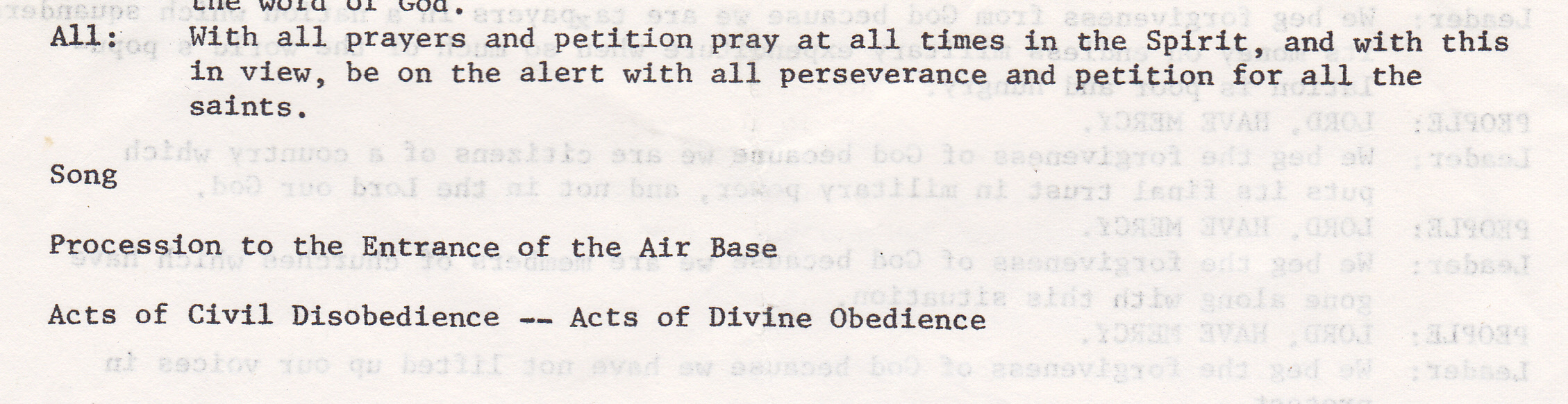
On Easter Sunday, 1980, I proceeded a with a group of protesters across a point of no return at the main entrance to Malmstrom Air Force Base near Great Falls. We walked forward deliberately and slowly against the previously delivered warning of the airmen guarding the gate.

We had come in protest to the presence around Malmstrom of the largest missile field in North America. Over this vast area in north central Montana the rolling grassland was dotted with over 200 underground silos, each the home to a Minuteman ICBM armed with warheads capable of unimaginable destruction : city-killers. They were all aimed at targets in the Soviet Union. Undoubtedly, somewhere in the USSR, there were missiles pointing not only at US targets, but directly at this missile field.

At 16, I was the youngest among the protesters. As we walked in a straight line over the threshold, we were arrested and taken to a holding room.

It was a combination of fear, anger and conviction that drove me to join this group and decide to get myself arrested in protest. But it originated wholly of fear, when I was ten years old. I remember the day.
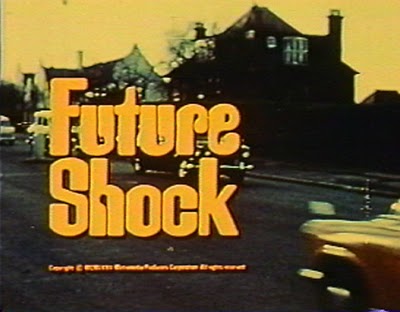
It was in the fall of 1973, and I was in my first months at the Open Community School. The Middle Group (mostly 2nd, 3rd and 4th graders) was shown a 1972 documentary film based on Alvin Toffler’s best-selling book, Future Shock.

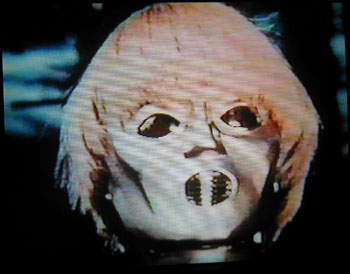
It was narrated by Orson Welles, and had the effect (on me, at least) of a dead-certain prediction of things to come. At times silly and dated, and full of what are now pop-sociology cliches, it was nevertheless disturbing and at moments terrifying, as was the opening montage. Imagine how it looked to 8-, 9- and 10 -year- olds!

It warned of cyborgs, human clones, social disintegration and technological change running “out of control.” In the latter part of the film, we see some protesters chanting, “Ban the bomb!” followed by Welles: “Sometimes technology can destroy. Amchitka. An underground nuclear explosion. When will the next nuclear blast occur, and what will it do to us?” A few minutes later Toffler was on camera, saying to some college students, “…The technology is so powerful and so rapid, it could destroy us if we don’t control it.”

This was the first I had heard of nuclear weapons and the threat they posed to us. After the film our teacher explained a little about the arms race, weapons stockpiles, and the MAD (‘mutually assured destruction’) doctrine.

Well, I was deeply troubled. We were talking, after all, about the end of the world. If that weren’t enough to rock my ten-year-old world, we were later treated to another documentary.

About Hiroshima.

At the A-Bomb (Genbaku) Dome, Hiroshima Peace Memorial, 1991

I have not been able to track this film down, but I do know that it incorporated footage of the aftermath that had only just been declassified by the US Government in 1973. The film showed horrific images of the dead and dying, and survivors of the atomic blast. I’d never seen anything even remotely as appalling or frightening.

We were told that the superpowers possessed enough weapons – even hundreds of times more destructive than the Hiroshima bomb – to kill every person on the planet a hundred times over, and if we got into a war with the USSR, the world would be consumed in a global nuclear annihilation.

Wow. Bummer!


This was the worst news I’d ever heard. It haunted me for the next eight years. The following school year I was spending the night at the rural home of my friend, Todd Mecklem. We always stayed up and watched Sinister Cinema, but rarely made it through the second feature. As I slept, I dreamed.

I was sitting on the steps of our house. There was the sound of an air raid siren, and prop planes overhead. Someone pointed at a plane in the sky. Next, I was heading for shelter. I entered a large room with high ceilings. It looked like a bank lobby, with the curtains drawn over large windows. Scores of people were crowded in and sitting on the seats and the floor. I saw my mom, and sat with her. Dread filled the room, I felt it. We were waiting. Waiting for the bombs to drop. I knew if they did, it was the end.

That was the first nightmare I had about imminent nuclear doom, but not the last. The others were just variations: with my dad, in a car, racing for shelter — and the blinding flash.

As I thought about it I realized that what really troubled me was not the prospect of death by itself; even for a kid, my own death was not nearly as terrible as the death of everyone, the whole world.
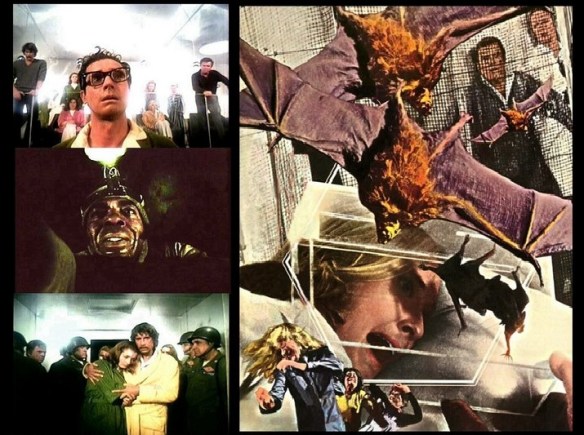
Chosen Survivors (1974). They escaped nuclear conflagration against their will, only to be overrun by killer bats. The irony!

Over the years, my fear was fueled by movies such as the Planet of the Apes series, The Omega Man, Logan’s Run, Chosen Survivors (one of the worst movies I’ve ever seen), Dr. Strangelove, and Peter Watkins’ The War Game. I seemed to keep hearing that the future promised either: untold wonders of technological advances, space travel, medical miracles, etc. — or: total annihilation. As I got older and the fabulous space age did not emerge, it was looking like the annihilation-thingy was only a matter of time.

I don’t feel safe in this world no more
I don’t want to die in nuclear war
I want to sail away to distant shore

-Ray Davies, “Apeman”

When I was a sophomore in high school, I saw a documentary on the arms race featuring a retired US Army colonel who was an antinuclear activist. I began to see how I could turn what was only helpless fear into activism and hope. I figured if you saw something wrong with the world you should work to fix it or sit down and shut up. And what was wrong with the world in my view was the existence of the weapons. So the obvious solution was to get rid of them, was it not? I decided to inform myself. I sent away to Sojourners, and they sent me a packet with articles, ideas for activism, and a map. As I unfolded it, it revealed the contiguous US and drawn on the map were all the nuclear targets in the event of a full exchange with the USSR. In Montana, where I now lived, it showed a huge area that represented the Minuteman missile field near Great Falls. The intent of the map was clear. In that, it was successful. My fear was refreshed, and outrage was now added, and I set about seeing what I could do.

I became associated with leftwing activists at the University of Montana, the Student Action Center. I started a polital action club at Hellgate that I modeled after SAC: the Union for Student Awareness (USA).
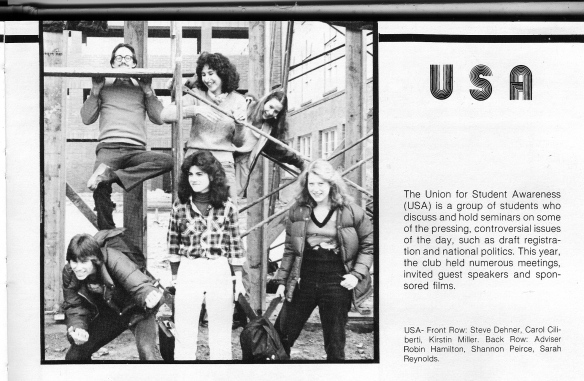
 

USA Club Hellgate HS 1980

I asked my English teacher, Robin Hamilton, to serve as advisor. He now serves in the Montana legislature.

SAC was planning an action for Easter (April 6) preceded by a week of meetings and forums on war & peace issues. On Monday, March 31st, the week’s featured speaker appeared on campus: Philip Berrigan, half of the famous Berrigan Brothers, the anti-war clergy-activists of the 60s and 70s. Just five months later they would launch the Plowshares Movement. In between noon and 8pm talks, he met with SAC and those would participate in the Easter Vigil action. We asked him questions about civil disobedience and the issues of the day. I told him I was planning to get arrested on Sunday, and he commended me for it.

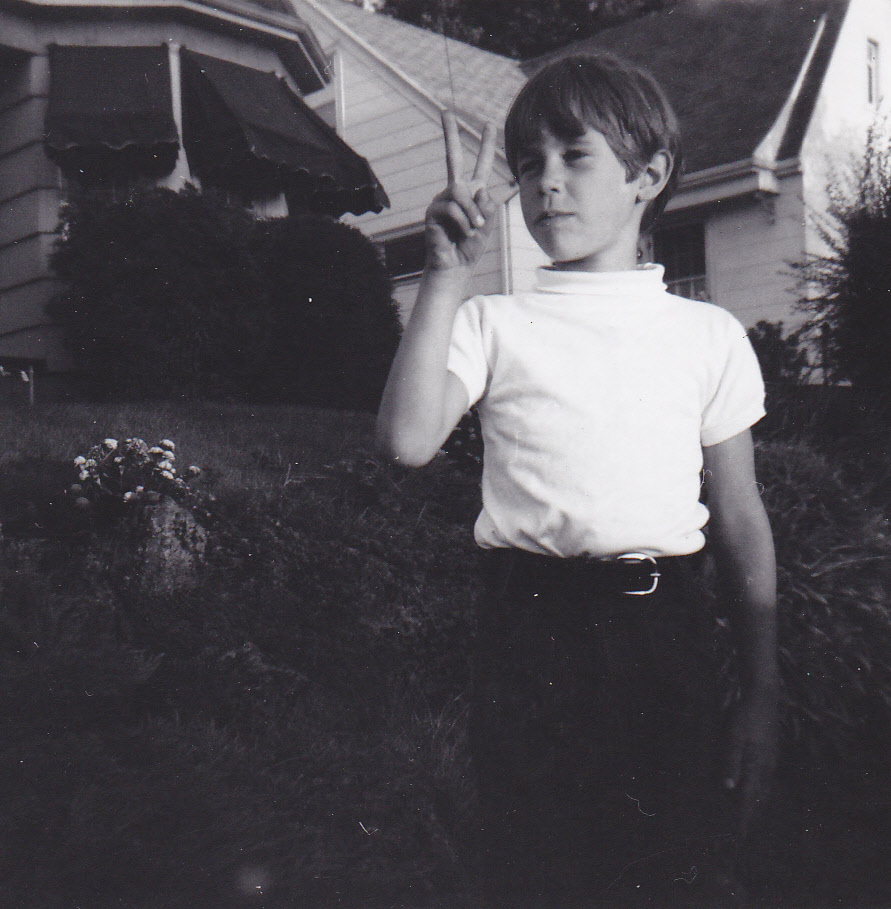
Two fingers, right? 1970, age 7.

It felt great to have a legend of the anti-war era, a man who spent years in jail for acting on his convictions, give me a pat on the back. But there was another person whose approval meant a lot more to me than Phil Berrigan’s: my Dad. He too was an anti-war activist who went to jail for his protests, and as a 7- and 8-year-old, I had accompanied him to planning meetings, marches and pickets. In finding what I thought was a good outlet for my anti-nuke feelings, I had also found a way to emulate Dad. Secretly, I hoped it would earn his respect, something most boys crave from their fathers.


On Saturday night they offered a free showing of the famous 1974 anti-Vietnam war documentary, Hearts and Minds, another film that I (again, alarmingly) had seen when I was about 12. The film was going to be delivered on Friday, so I asked SAC if I could show it Friday night at Hellgate. They agreed, as long as I confined my advertising to the high school. I plastered fliers all over the school with just a day or two’s notice. I had to go over to the U campus and walk the film back to school, a herculean task I was barely able to manage. We had an enormous turnout and it was the most successful event USA carried off. Late that night I walked the reels back to the campus.
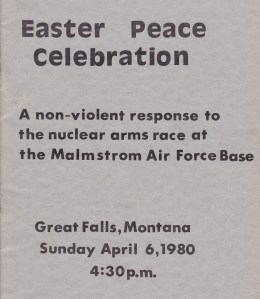
The Easter Vigil was led by John Lemnitzer, a Lutheran pastor, and Terry Messman from SAC. The group met on campus and we drove up to the the Base. The Vigil and the action were planned and intended as a Christian tesimony to the evil of war and its weapons. There were those in the group, including myself, however, who would not have identified themselves as Christians, but we would have agreed that the statement of the Vigil was in accordance with Christian teaching, and that was good enough for us. We stood outside the gate and sang a few songs. In particular I remember the one from the 20th Psalm:

Some trust in chariots
And some in horses
But we will trust in the name of the Lord


When we crossed the line of trespass, the guards escorted us to some concrete room, where we spent hours being processed and awaiting our disposition. When I decided to get arrested, I had agreed to accept whatever charges and sentencing I might receive. I had my parents blessing in this. I did not know how it would turn out. At the end of the day all but John and Terry were released and no charges were brought against the rest of us.

When the final results were tallied, the nukes were still in their silos and we were going home with a great sense of satisfaction. But as any radical knows, that is not one’s general experience in life. A radical eventually comes up against the annoying little fact that hardly anybody in the world, even your non-radical friends, really see things the way you do: that’s why you’re called a radical. When I would venture to claim that we were in danger of incinerating the entire human race, I’d be met with, “Wow. Bummer!” and a shrug.


This failure of the rest of the world to see the outrage it should have leads to constant frustration. This is why radicals inevitably grow angry and resentful. They come to hate American society (If they didn’t already) for it’s moderate-to-conservative outlook, and their own inability to change it. “If no one can see things as I do, they must be morons! Or corrupt. Corrupt morons!” Americans in a nutshell, for your average radical.

I quickly started down this path. But I think I had some sense or at least some doubt about where it was heading. It may have been that I was just growing a little more pessimistic about social change. After the elections of 1980, it did not look as though things were going our way. That didn’t mean I wanted to give up, I just meant I would have to come to terms with things as they were.

That would have to include the finger of the maniacal, wild-eyed, warmongering Ronald Reagan resting on the “Blow-up-the-world” button. (As it turned out, few things have increased the security of the world as much as ending the Cold War without letting it erupting into a hot war. And history has given the primary credit for that feat to the warmonger Ronald Reagan.)

After my rebirth in 1982, I looked at the prospective end of the world in a very different way. I believe that God has committed to humanity the stewardship of the earth, but not its fate. Human history and its ultimate disposition are in His hands, not ours. But I also eventually came to look at weapons differently as well. Weapons alone are not fearful. The evil that can be done with them proceeds from the human heart, the ultimate weapon of mass destruction. A knife, a club, an airliner – they only pose a threat in the hands of someone of ill-will. Men as powerful as Hitler or Stalin had no atomic weapons before 1945, but look what they had done by then. Nukes have not been used since 1945, but we shouldn’t assume that it has nothing to do with the people and nations that have them. Turn just one nuke over to Ahmadinejad and you can march, chant, trespass, and pound nose cones all you want, but if you live in Tel Aviv, you’re dead.

In my view I wasted my time on any effort to get nuclear weapons out of the hands of responsible nations that would probably never use them. And as far as activism goes, it will never wrest such weapons from the nations or groups that would use them. You can only try to stop them from acquiring them and keep the price very high for using them. For that, you need the US government and its military forces.

Passing on The Passion

It’s been more than six and a half years since The Passion of the Christ was released. I still have not seen it. This is by choice, not by chance. Since I am writing a series of reviews of all the major films that portray the story of Jesus, I thought I should explain why this one – by far the most popular and highest-grossing Jesus movie ever – is being omitted, at least for the time being.

My reasons are both personal and theological. Let me say at the outset that my reasons have nothing to do with the man who made the film, Mel Gibson. Even though I think his personal life indicates that he is a deeply troubled man with some serious failings, that alone would not keep me from seeing it. After all, Richard Wagner was at least as flawed, and I listen to his music. Also, the fact that the film was controversial would not have kept me away. The Last Temptation of Christ was also controversial, and I saw it. More on this point later.

The film was released three months, almost to the day, after the death of our 13-year-old son in an automobile accident. At the time our 11-year-old daughter had just awoken from two and a half months in a coma, and my wife was living at the hospital with her. At this point any sensible person would say that alone was reason enough why I wouldn’t go running off to the movies. But actually, just once I had gone to the movies (The Return of the King). And I wish I hadn’t, at least when I did. But one typically considers seeing a movie when everyone else is seeing it, when it is being widely discussed and, in this case, debated.

I went though a lot of anguish and inner struggle over having lost my son. As a Christian, it was not a crisis of faith so much as a trial of faith. I felt like the soldier on the battlefield who is having his leg amputated after the anesthetic has run out. I know I can live through it, and know I must endure it, but that does not take the pain away. Will the fire refine me or burn me up?

One thought that kept recurring was that God the Father had also lost His Son to the grave. I would always think, “Yes, but that was only for three days; this is for the rest of our lives.” I eventually came to believe that the difference I perceive between three days and the rest of my life will someday evaporate in light of eternity. If you were to say, “But God knew that His Son’s death was only temporary,” I would say, “So do I.”

All of this to say, I couldn’t contemplate watching a whole movie that focused on Jesus’ death. Death had gutted me: I’d had enough of it. “Well, it wasn’t just any death. Maybe it would have helped.” I doubt it.

Another reason: I was horrified at reports of people walking into the theater with their little kids, buckets of popcorn and half-liters of pop as if they settling in for Toy Story. This is not just a movie, and it is certainly not for the little ones. This is like Schindler’s List or Saving Private Ryan. It calls you to witness a harrowing portrayal of suffering that will not amuse you. It is not entertainment. Perhaps in a few months I could sit through such an experience, but I could not sit with such an audience. I certainly could not abide people subjecting their children to such an ordeal. I would have to watch it alone.

I know that the movie was charged with portrayals that some took as anti-Jewish (The movie had Jewish defenders as well as detractors). Without having seen the movie, let me assume that it reflects the gospel narratives. The gospels have a polemic nature, so there are antagonists and protagonists. It should be pointed out that while some of the antagonists are Jews, practically all of the protagonists are. But more significant is that, while in Jesus’ arrest and trials the key actors are the Jewish leaders, in his execution there is a clear and necessary joining of Jewish power and Gentile (Roman) power. Any fair reading of the texts would bear this out. This fact also has a theological significance for the early church:

So when they (the Christians) heard that, they raised their voice to God with one accord and said: “Lord, You are God, who made heaven and earth and the sea, and all that is in them, who by the mouth of Your servant David have said:
‘Why did the nations (Gentiles) rage,
And the people plot vain things?
The kings of the earth took their stand,
And the rulers were gathered together
Against the LORD and against His Christ.’
For truly against Your holy Servant Jesus, whom You anointed, both Herod and Pontius Pilate, with the Gentiles and the people of Israel, were gathered together to do whatever Your hand and Your purpose determined before to be done.” (Acts 4:24-28 NKJV)(Parentheticals mine.)

Jew and Gentile, who were separate and opposed, came together in agreement that Jesus should die. In this collaboration they represent all of humanity. Luke, the only Gentile NT writer, makes a point of telling us,

That very day Pilate and Herod became friends with each other, for previously they had been at enmity with each other. Lk. 23:12

Of course, I would have to see the movie to know for sure, but if the charge is that the movie is anti-Jewish because the New Testament is, I don’t accept the premise. Just because the Jewish leaders are villains does not make the narrative anti-Jewish. All the the heroes are Jewish as well – not the least the rabbi Yeshua himself.

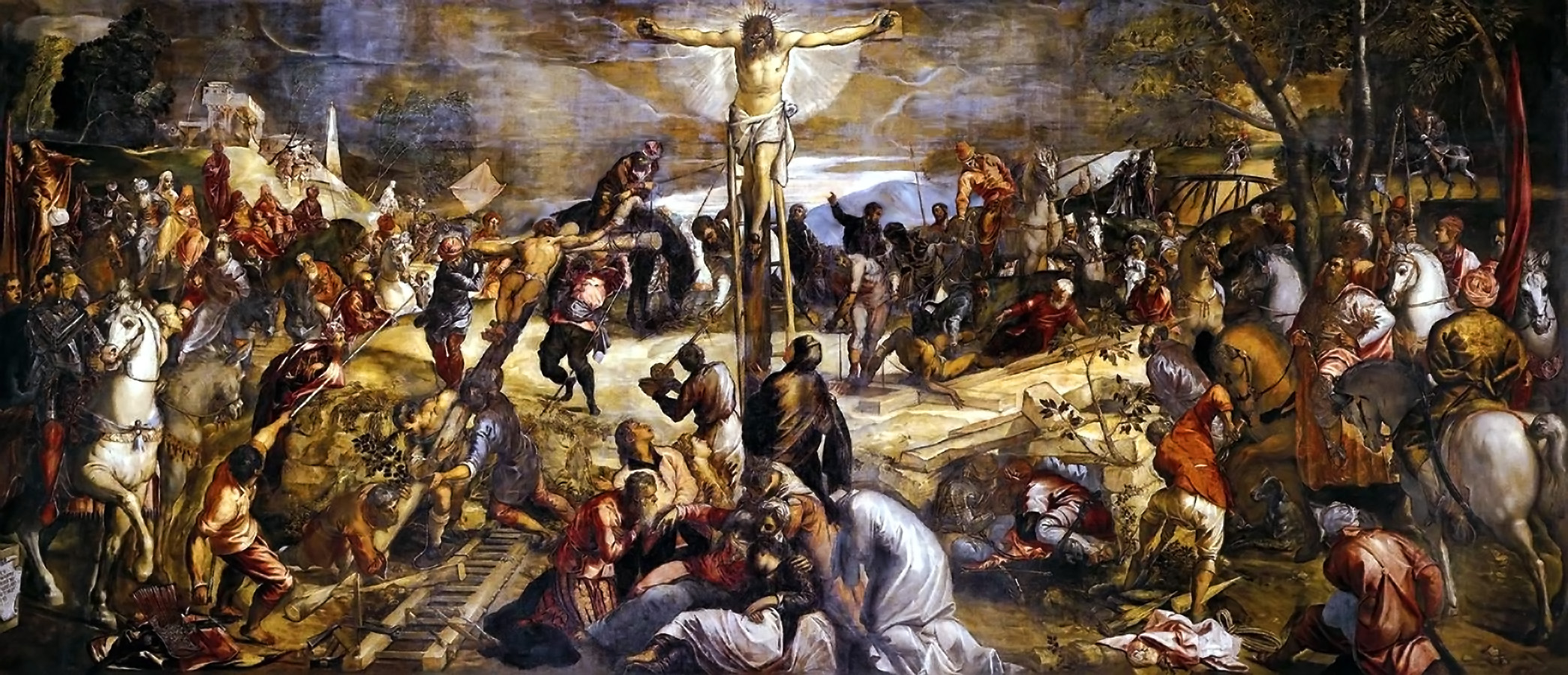
Finally, my interest in the film is dampened by by the apparent emphasis it has on the gruesome nature of Christ’s sufferings. I have no doubt that the torture and mutilation it shows is without exaggeration. I have seen plenty of stills, and a few clips from the movie. I have also seen most of the major Jesus movies, with their typically mild depiction of the passion. Tiny stripes with little streaks of blood. This is for two obvious reasons that I can think of and one less obvious. The audiences and the level of violence that both they and the censors (when they reigned) would have tolerated would not permit of a graphic rendering of Jesus’ torture. Second, most people would like to consider the story of Jesus a family movie, and not want the little children of the world to be exposed to such horrors. The less obvious reason is that most Jesus movies, from the silent era on, drew their imagery and staging from Christian iconography – most commendably from great renaissance painting and sculpture…

…and more regrettably from lesser forms of popular art, like those found in old family bibles or on prayer cards.

The Passion is to those sanitized portraits, I imagine, what P.O.D. is to Evie.

But I think there is an even more important consideration. I have sat through at least a half dozen sermons in my life that did in words what The Passion has done on film: draw attention to the gore and mutilation of the passion. The speaker usually goes for the effect of horror or revulsion and then says something to the effect of, “He suffered all of this for you.”

And it’s true. He did suffer these things on behalf of everyone of us. The New Testament says this very clearly, and I do not disagree. But what it does not include is any of the vivid details. That’s because it was neither necessary – most readers and hearers were all too familiar with the cruel practices of the day – nor was it central to the point of His sufferings.

The meaning of His suffering is profound, and it is considered from more than one perspective in the NT. We are to understand it as the ultimate form of humilty and obedience.

And being found in appearance as a man, He humbled Himself and became obedient to the point of death, even the death of the cross. Php. 2:8

It is a model of suffering for us, that is, it makes our character and conforms it more to Christ’s.

For consider Him who endured such hostility from sinners against Himself, lest you become weary and discouraged in your souls. Heb. 12:3

It paid the penalty in full for all the sins of the world.

For Christ also suffered once for sins, the just for the unjust, that He might bring us to God, being put to death in the flesh but made alive by the Spirit…1Pe. 3:18

And He Himself is the propitiation for our sins, and not for ours only but also for the whole world. 1Jn. 2:2

It reveals the full extent of God’s love for humanity.

In this is love, not that we loved God, but that He loved us and sent His Son to be the propitiation for our sins. 1Jn. 4:10

To understand this should not require – and apparently the writers of the NT agreed – a detailed mental image of butchery and mutilation. The point of His torture and death is spiritual and theological not physiological. To have witnessed the events would have elicited an R-rating, but to understand what they meant in the fullest sense certainly does not.

Perhaps someday I may feel differently about the prospect of watching The Passion of the Christ. From what I have read, it is an extraordinary film. But it is hard for me to foresee gaining so much from it that it would outweigh the ordeal of watching it.

Straw Wars

(Warning: There there is an outside chance that reading this post will throw some very cold water on the fire of your love for the Star Wars films. If this is unacceptable to you, skip it. – SD)

This week my dazzling bride was teaching Sunday school and I was assisting. One of the boys, age 8, said, “Today I’m going to watch Star Wars!”

“Which one?” I asked.

“One,” he responded, minimalistically.

“With the little guy.”

“Uh-huh.”

“And the metacholorians.”

“The what?”

“Better ask your dad to explain it. Fun stuff. And the trade embargo. Very exciting.”

“What?”

Two thoughts came to mind. One is, I may be a little too facetious for the first- and second-graders class. But that will be for another post.

The other is that I am still mourning my lost love for Star Wars. Even though its been exactly eleven years since the first of the last three films began to undermine my enjoyment of the first three films, it still irritates me that the sterile, fun-free, computer-generated episodes have the effect of diminishing movies that were a kind of cultural laser cannon cutting through the nihilistic gloom of 70s cinema.

How did this happen? Well, it feels as if your grandpa dragged all your childhood toys out of a closet and pounded the daylights out of them for six hours. You can revive your enjoyable memories, but you’ll never look at them or grandpa the same way.

Grandpa is, of course, George Lucas. He took all your old imaginary friends and pounded every last sign of life out of them. He made them silly and boring. He bogged them down in trade disputes, embargoes and – heaven help us – politics. Worst of all, he infected all three films with something the first three were refreshingly absent: cynicism. Yuck. For that I can go back and watch old Billy Wilder films. His cynicism was at least entertaining. None of my kids at any age have had the least notion of what these movies are about. Heroism? Valor? Good versus evil? Outnumbered democratic republicans versus the evil empire?

Uh, no. It’s about the whiniest, moodiest teenage Jedi punk you ever laid eyes on.

Sorry kids, in this movie the good guys stand around, clueless and feckless, muttering dark suspicions while the empire rises under their noses. Fun for the whole family!

When Episode One came out, I told my friends that I thought Lucas had failed in deciding who the films should be about. He chose Annakin Skywalker, committing himself to a downward, suspense-free story arc in which the main character sinks ever deeper into himself and the dark side. It was bound to be a complete bummer, and as it turned out, it was. In my view, the story in these episodes should have been about Obi-wan Kenobi.

Here’s why. In episodes 4 – 6, it was Obi-wan that represented the heroic era of the Jedi upholding justice and goodness in the last days of the Republic. I would have shown the Republic in its glory, with Obi-wan as it’s central hero. Heroism, after all, is at the core of the old movies. Lucas, now a rather cynical used-to-be, has given us instead a darkly political-economic (instead of moral) view of the Republic as the late Weimar (with passing suggested equivalence with US), a rotting corpse of a state ready to be displaced by energized fascists. Again, yuck. (In other words, Lucas has shown us what Star Wars would have been like if he had been in the same gloomy mood as the rest of Hollywood in the late 70s.)

Showing the glory days of the Republic would have illustrated what it was that the Rebels were later fighting for so valiantly. It would have made sense. And it would have been fun, just maybe. In my story, the Skywalker story would have been secondary, and probably confined to the third and perhaps the second episode. Sure, show the rise of the Empire, but for crying out loud, have something decent to contrast it with! Lucas gave us a completely lame Republic that left us wondering what the rebels would have even been fighting for 20 years later. Sadly, I’m afraid it is Lucas himself who could no longer pretend to believe there is anything worth fighting for, so, in a sense, if there is such a faith in the old movies, he has now renounced it.

By contrast, consider the theme in the vastly superior Lord of the Rings tilogy:

Frodo: What are we holding onto, Sam?

Sam: That there’s some good in this world, and it’s worth fighting for.

– From The Two Towers

LOTR managed to portray evil in three dimensions, while rejecting both naivete and cynicism. Star Wars, all six films, suffer so much in comparison to this masterpiece of mythic – truly mythic – storytelling, that it is hard for me to ever see the old movies the way I did as a teenager when they were new.

In fact, the supposed mythic underpinnings of the first three films are quite open to question. This salon.com article from 2002 blows some big holes in the SW mythical mythmaking.

Lucas has made many statements such as this one in an interview in the April 26, 1999 issue of Time:

“With ‘Star Wars’ I consciously set about to re-create myths and the classic mythological motifs,” Lucas says. “I wanted to use those motifs to deal with issues that exist today.”

The Salon piece by Steven Hart points out that Lucas’ “inspiration” for SW was largely pulp sci-fi (and more respected works), not the mythic themes of the ancient epic story-tellers. But grasping the weight that could be lent his films by making such claims, Lucas, sometime after the first film was out, began citing, not old sci-fi pulp mags and paperbacks, but revered samurai films and the writings of Joseph Campbell (who himself deserves to be taken down a few credibility notches). These claims have only grown more pompous and inflated over the years. And his attempt to “deal with issues that exist today,” accounts for most of my complaints about the last three episodes. If I wanted him to do that, I’d suggest he get a cable news show. I prefer he tell a good story and have some fun doing it. I personally don’t need an intellectual or high-culture justification for enjoying a movie. Especially a fake one.

In spite of all this, I can actually still find enjoyment, even if diminished, in the first three films. But I have to try to forget all the silly claims of seriousness and purported involuntary submission of my subconscious mind to George Lucas’ all-powerful myth-making skills. I have to try and watch them as I did when I was was a thirteen-year-old boy watching Star Wars for the first time at the movie theater in Seaside, Oregon in the summer of 1977. I had been nurtured on Ray Harryhausen, Arthur Clarke, Ray Bradbury and Rod Serling, but rarely had experienced their kind of story telling on the big screen. Star Wars exploded before our eyes with magic, imagination, heroism and fun.

That’s why we loved it, George.

Autoblography: Introduction

This is not a background bio, or even a conventional memoir. It is more of an experiment I thought of a couple of years ago, and which I’m sure is not original. The thought was to write a memoir over a long period of time, consisting of posts covering different aspects, experiences and observations from my life. It will not be chronological. My idea is to organize posts around themes and threads running through my experiences, as well as episodes, stories and sketches.

I have no idea where this will take me. Wanna come?

Autoblography Page

——————————————————————-

Here is a little chronology so you can figure out where the different posts fit into the scheme of things.

1963
Born in Portland, OR

1963-1976
Lived in NE Portland

1972
Parents divorced

1973-1976
Open Community School (Grades 4, 5 & 6)

1976-77
Seventh Grade in Estacada, OR

1977-78
Back in Portland for 8th Grade

1978-1981
Lived in Missoula, MT and attended Hellgate High School

1981-1982
Lived in Seattle; spent the summer of ’81 in Missoula.

1982
Moved to Portland; hitchhiked to New Mexico, then to Oklahoma City

1982-1985
Lived in Oklahoma City

1984
Married Laura Weatherly

1985-1992
Lived in Portland

1986-1988
Portland Community College

1992-Present
Lived in Forest Grove, OR

1992-1995
Pacific University