When Was the First Christmas? A Minority Report

You’re a Superstar
What difference does it make when Jesus was born? Answer: Identifying the Star of Bethlehem as both an astronomical event and a meaningful sign. If the star was a natural phenomenon, then which one it was depends on when we date the birth of Jesus. I happen to believe the date most commonly accepted – between 6 and 4 BCE – is open to question and a later date to be preferred – and I’ll tell you why.

The dating of Christ’s birth is calculated from one event: the death of Herod, a specific historical event referenced in the Gospels. And how is the death of Herod dated? It is calculated from a specific astronomical event, namely a lunar eclipse. Most historians assume this eclipse to have been the one that occurred on March 12/13, 4 BCE. But that is not the only lunar eclipse that could be used to date it, and if a later eclipse is more likely, we also find an even more dramatic series of astronomical appearances in the Middle East – whose meaning would have been profound to star-gazers of the day – that occurred before and at the time of this later date for the birth of Jesus. We call these appearances the Star of Bethlehem.

Someone is bound to object that the Star of Bethlehem was a purely miraculous, i.e. supernatural, event. However, there is no explicit statement in the gospel narratives that requires us to believe that the star is something more than a natural, albeit extraordinary, phenomenon. (Regarding Mt.2:9, see below.) It served as a sign, I would contend, because of its timing and its meaning. So what was the timing and the meaning?

When did Herod die?
According to Matthew and Luke here is the order events around the birth of Jesus:

  • Augustus orders a census for tax purposes
  • Joseph and Mary travel to Joseph’s ancestral home of Bethlehem
  • Jesus is born, circumcised and presented in the temple
  • The Magi arrive in Jerusalem and are questioned by Herod
  • The Magi find Jesus in Bethlehem
  • Herod orders the massacre of Bethlehem’s male infants
  • The family flees to Egypt
  • Herod dies
  • The family returns from Egypt

In order to date these events, at least one of them must have a fixed date, and that event is Herod’s death. The Jewish historian Josephus describes the circumstances of his death. Herod ordered the execution of two dissident rabbis on the same night as a total lunar eclipse (Antiquities, 17.167). He died shortly afterward. Most historians hold that the eclipse referred to is one that happened on March 13, 4 BCE. Shortly after his death was a Passover, indicating that it was spring. Herod had ordered the death of all boys two and under in Bethlehem, strongly suggesting that the Magi told him the star had first appeared some two years before their arrival.  Herod concluded that the birth he was worried about had happened sometime in the previous two years. Thus, Jesus’s birth is placed in 6-4 BCE, on the assumption that Josephus’ eclipse was in 4 BCE.

Jesus’ birth                                                   6/5 BCE ?
The Bethlehem Massacre                        5 or 6 BCE ?
Herod’s death                                March/April 4 BCE

Are there reasons to question this dating? Yes, a few.

1. According to Josephus, a lot of things happened between the eclipse and Passover, which fell on April 11 in 4 BCE. That’s less than a month. The other proposed early date of 5 BCE has a lunar eclipse on September 15/16, but Passover is seven months later.

2. A proper reckoning of Herod’s reign begins with beginning of his first full year of reign on April 11, 35 BCE. Josephus places Herod’s death in his 34th year of reign, which began on April 6, 2 BCE.

3. Most of the early Christian scholars date Christ’s birth to 2/3 BCE: Irenaeus, Clement of Alexandria, Tertullian, Africanus, Hippolytus of Rome, Hippolytus of Thebes, Origen, Eusebius, Epiphanius, Cassiodorus Senator and Orosious. All these people had a much better handle on the reckoning of time in the ancient world, and likely had access to records that no longer exist. No early historians give a 6-4 BCE date.

4. Another, later eclipse fits the timeline better. It was on Jan. 10, 1 BCE (there were no lunar eclipses in 3 or 2 BCE). The Passover was twelve and a half weeks later, allowing time for the events between the two, while Herod’s death could still be described as shortly after the first and shortly before the second.

In other words, Herod may in fact have died three years after the accepted date. In which case, the early historians, forming a consensus, may have been correct in assigning a later birth date. But there are even more compelling facts to consider.

“We Have Seen His Star”
How about celestial occurrences that we could identify as the Star of Bethlehem?

“Some may regard the star as entirely mythical, some as completely miraculous, but it is also possible to suppose and inquire after an actual celestial phenomenon back of the account.” – Jack Finegan (1908-2000)

We should go where the evidence leads, but I favor the  latter approach – investigating an event that can be verified independently of Scripture – for the following reason. The star as presented by Matthew is a sign to the non-Jewish world, and it is a sign that was not to be read about 60 or 70 years later. An immediate sign for people who would take note of it and seek to understand what it meant and what it pointed to. A miraculous star does not rule this out, but how much greater a sign it is, if in fact it is an astronomical event whose factual-historical nature stands unquestioned throughout all history to come – like the stars and planets themselves. So if there is such an event, and it happens to line up with the other events under consideration, we should not rule it out because it is not strictly supernatural. But Matthew 2:9 has this peculiar account:

When they heard the king, they departed; and behold, the star which they had seen in the

Zodiacal light: after dark, sunlight is reflected off of space dust and scattered.

Zodiacal light: after dark, sunlight is reflected off of space dust and scattered.

East went before them, till it came and stood over where the young Child was.

Not exactly how you expect a star or other celestial body to behave. But the planets could have reached their stationary points at that very time; they would seem to “stand still.” Also, there could have been a concurrence of zodiacal light which creates the appearance along the ecliptic of a beam of light (actually sunlight) and can seem to be shining down on the earth like a spotlight.

In short, a completely natural phenomena, but serving a divine purpose at a divinely appointed time.

Those who hold to 4 BCE for Herod’s demise can point to a number of astronomical phenomena which could account for the appearance of the star.

The Chinese recorded a nova (or a comet) in 5 BCE (appearing for 70 days, perhaps more), and another in 4 BCE. In 7 BCE there was was a triple conjunction of Jupiter with Saturn in Pisces, with Mars also coming close.

But what if we accept a later date of 1 BCE for Herod’s death? If Herod ordered the massacre sometime in the last months of his life, it points back to 3 or 2 BCE for the birth. In those years there were no novae or comets, but there was something even more remarkable for its astrological meaning and its allure to the Magi.

Finegan (550*. Emphasis mine):

On the morning of August 12, 3 B.C., Jupiter and Venus rose in the eastern sky, an event which could ave been what was meant when the magi said, “We have seen his star in the East,” or “in its rising” (Matt 2:2). (The word ἀνατολῇ means both the “rising [of stars]” and the “place of the rising [of the sun],” i.e., the East.) In this conjunction Jupiter and Venus were so close they were almost touching each other. From the point of view of astrological symbolism, Jupiter is the king planet and Venus (Ishtar in Babylonia) a female; so their conjunction can suggest a coming birth. The conjunction took place in Leo (the Lion) and near the bright fixed star Regulus. Regulus is the king star and the Lion constellation is the tribal sign of Judah…Afterwards Jupiter moved on to be in close conjunctions with Regulus three times (a triple conjunction on Sept 14, 3 B.C., Feb 17, 2 B.C., and May 8, 2 B.C.), then June 17, 2 B.C., came into again into conjunction with Venus, this time being so close that without a modern telescope the two planets would have looked like a single star. In the fall and winter 3/2 B.C. Jupiter appeared to stop several times against the background of the stars; and on June 17, 2 B.C., Jupiter and Venus were in extremely close conjunction and shone almost like a single bright star in the west – in the direction of Jerusalem as seen from Babylonia. With these phenomena we may compare Matthew 2:9: “The star which they had seen in the East went before them, till it came to rest over the place where the child was.” If the magi were students of astronomical events it can theorized that the appearance of this star on June 17, 2 B.C., was the final heavenly sign that impelled them in the late summer or early fall to Jerusalem and Bethlehem, where they found the child Jesus, ‘who was born some time during the previous year and a half.’

This is what the magi saw that foretold something they perceived as of immense importance to the world:

The king planet came together with the woman/maiden/mother planet in the constellation of the tribe of Judah – the tribe of David, Joseph of Nazareth and Jesus. Then the king planet came together with the king star – emphasizing the royal significance – not once but three times. And during the first of these, the sun was in the constellation of Virgo – the virgin. Then the king planet and the woman reunited, appearing as one.

Finally, on the winter solstice of 2 BCE, Jupiter reached a stationary point, “in the constellation of Virgo (the Virgin) when Jupiter was directly over Bethlehem, about 68 degrees above the southern horizon as viewed from Jerusalem where the magi were.”

I don’t believe in astrology, that our fate is governed or revealed by celestial movements, but the magi probably did; that’s why they followed the ‘star.’ And I believe something even more rational and wonderful: that God, the Creator and Sustainer of all things, synchronized the heavens with his unfolding plan of redemption and revelation. He spoke to a watching, wondering people, in the stars and planets sparkling in the night sky. He spoke their language, and bid them Come and see. I don’t know about you, but it fills me with awe.

We know, astronomically, what happened during those months. For those of us who believe, we also know what happened historically there in Bethlehem. It’s easy to imagine how jubilant the magi must have been at the discovery that lay at the end of their long journey and the years of sky watching that preceded it.

When they saw the star, they rejoiced with exceedingly great joy.
-Matthew 2:10

They rejoiced because what they anticipated from their interpretation of the planetary and stellar paths was the birth of a great King, the Lion of the Tribe of Judah, and they came to honor and worship Him. The Star – the king planet and the king star shining in the house of the virgin – and words of the prophets, had led them to Him.

The heavens declare the glory of God;
And the firmament shows His handiwork.
Day unto day utters speech,
And night unto night reveals knowledge.
There is no speech nor language
Where their voice is not heard.
Their line has gone out through all the earth,
And their words to the end of the world.
{Psalms 19:1-4a}

——————————————————————

*These numbers are Finegan’s section numbers, rather than page numbers.

[This article is essentially a summary of some of the relevant sections from Jack Finegan’s Handbook of Biblical ChronologyRev Ed. (Peabody: Hendrickson, 1998). I have done no independent research here. Finegan, a professor of New Testament History and Archeology,  was a master of the subject. The book is extremely complex, and challenging to follow, so I have long wanted to write a digest of this topic that was more accessible.]

Here is a chronology of the period incorporating some of Finegan’s conclusions. Any errors are mine.

EVENT                                          DATE       YEAR         FINEGAN #
Jupiter+Venus near Regulus  Aug. 12     3 BCE          550*
Jupiter+Regulus (1)                Sept. 14     3 BCE          550
The Enrollment             Before Feb. 5     2 BCE          519 – 526
Jesus’ Birth                             January     2 BCE          569
Jupiter+Regulus (2)                   Feb. 17     2 BCE          550
Jupiter+Regulus (3)                     May 8     2 BCE           550
Jupiter+Venus                          June 17      2 BCE           550
Magi leave                                Summer     2 BCE
Magi arrive in Jerusalem              Fall     2 BCE
Jupiter stationary in virgo     dec. 25     2 BCE          551, 547
Magi go to Bethlehem & see Jesus
Joseph, Mary & Jesus flee to Egypt
Slaughter of the Innocents                                       508-510
Total lunar eclipse                 Jan 9/10     1 BCE          514
Herod’s Death                        Jan-March    1 BCE          501-518
 

How I Became a High School Dropout

(Warning: harsh language, drug use.)

Painted Black

At the end of the summer of 1980, my girlfriend Anna left for college, I turned 17, I began my junior year, got glasses, read Catcher in the Rye, assumed my post as Editorial Page Editor on the Lance, and badly sprained my ankle playing soccer. And I was at war with myself, total war.

As September cooled into October, a gloom began to settle over me that I couldn’t shake. I don’t know if it was clinical depression; it might have been. After spraining my ankle I was done with soccer, and any sports for the time being. I began to slack at school. My introspective tendencies were at their worst. As far as I could tell, it was all brought on by the pangs of Anna’s absence. I was overcome by negative feelings about myself and life in general. Smoking dope and drinking didn’t help.I was tired and, as always, walked around with a knot in stomach over school.

You know I’d give you everything I’ve got
for a little peace of mind
-John Lennon
I’m So Tired

Over the summer, my friendship with Mark and Troy grew stronger. In September, Mark, Troy and Dave Larson (my co-editor) had talked about traveling together in Europe, and as soon as they were all done with school was the perfect time for them to do it. Of course they didn’t have the money, so they would have to figure out a way to save as much money (and as quickly) as possible. One night, Dave came to my house and we walked through Bonner Park. He was very troubled. He asked if could confide in me, if I could keep a secret. Mark and Troy had come up with a scheme to make a lot of money fast: growing pot. A lot of pot. Dave found this very troubling, and needed  to get it off his chest. I suggested he decide if he was in or out, and let the other two do what they wanted. He told them he was out.

Shortly after that, about the end of the month, Mark and Troy proposed the Alliance: the three of us, backing a growing operation to fund a trip to Europe. I did not like the business plan, but the Europe trip – well, that was something I had dreamed of since I was 10 years old. I loved the idea. After arguing with them about my objections, I was in. As soon as I did, I began to mentally persecute myself over the decision. I was overcome with self-contempt for agreeing to help grow and sell drugs, mostly because I knew my motivation for opting in was easy money. In other words, I was guilty of one of the worst sins there was: greed.

I look inside myself and see my heart is black
I see my red door and it has been painted black
Maybe then I’ll fade away and not have to face the facts
It’s not easy facing up when your whole world is black
-Jagger & Richards
Paint It Black

That wasn’t the only problem. Mark was graduated, and Troy was going to finish early, at midyear, by taking correspondence courses. But I was not going to be done with school for 20 months. I don’t remember who first suggested it, but when I started getting F’s, not just on my work, but on my report card, I felt I had dug myself into a hole I could not dig out of. I truly believed this. And unless I gave up the parties, drugs and alcohol, I was probably right. I began to think about dropping out of school. In so short a time, my way of thinking about my future had been derailed by a half-baked pipe-dream.  No, I was not thinking clearly. And no, far from giving up drugs, I was branching out.  That fall, I took mescaline, the hallucinogen found in peyote, and tried Quaalude, the drug du jour.

Boy, did I feel rotten. I felt so damn lonesome.
-JD Salinger
Catcher in the Rye

I did this in the apartment Mark and Troy rented in Missoula. To get it they asked me for the remaining $300 I had earned in the summer. The apartment served two purposes: it allowed Mark to move out from his grandparents’ house and Troy to move out from his folks’, and it was to be the home of our growing operation, a scheme that began to fail before it ever got underway. For the few months they had it, it became my second home.

Meanwhile, my energies and creativity were focused on the Lance, where Dave and I edited the editorial page, and I continued drawing cartoons and writing my humor column, Nowhere Man. One night in early October, I worked late with other staffers on paste-up. Getting home about 11, I went up to my room and was listening to music, when the phone rang downstairs. I raced to answer it, as Dad and Jane were asleep, and It was Jeff Morgan on the other end.

“Some asshole  just murdered John Lennon,” sounding dismay mixed with anger.

“What?!”

“Some goddamn lunatic shot him on the street. He’s dead.”

“My God.”

To me and some of my friends, this was a cause of sadness and anger. Another death that waved a black flag before us. A warning, a revelation or perhaps a remembrance. I don’t know.

Bad news news on the doorstep
I couldn’t take one more step
-Don McLean
American Pie

The real fallout was a sense of disillusionment. Lennon symbolized much of what I had grown up with and had taken as my own attitudes and convictions over the last year. Within the counterculture vision I found a promise – of personal and social evolution – that I was desperately grasping for, but which I was already beginning to doubt as empty and impossible. It pointed to a deeper struggle I was lamely putting up: an illusory light, losing its struggle against a very real darkness. You might stand for such a vision, but skulking around the corner is a lunatic with a gun. There’s always one of those, isn’t there?

With my emotional and academic life in a seemingly irreversible tailspin, dropping out and moving away started looking to me to me like an escape hatch – and I wanted to escape. I was one decision away from making my problems go away.

In February I made the decision.

* * *

I realize that my problems were not very apparent to those around me. I was gregarious, always seeking the company of my friends, and never solitude. At those times, I generally aimed to be the life of the party, which often led to me just making a fool of myself without knowing it. On the outside, I was all laughs and good times. On the inside, my thoughts were serious and dark. I wondered what I really was, if my ideals meant anything, if life and the world and my dreams had any value or meaning.

In the fall I first listened to The Wall from beginning to end. It was a disturbing experience for me, a view of life as so unbearable in its losses and oppression and torments that alienation is inescapable and isolation the only recourse. At this time I first caught a glimpse of something that was just a plain horror to me: the notion that we were alone in the universe. No God, no ultimate meaning or purpose, no reality beyond the material and physical, no soul, no eternal: nothing. Just this life and then the grave, lived on whatever terms we could arrive at by our own wits.

The prospect that this was the truth, that this was the fact of our existence that science, reason, and philosophy presented us with – the fact that I must face, and must embrace –  it knotted my stomach and made my blood run cold. I did not accept it. I wasn’t ready.

If you should go skating
On the thin ice of modern life
Dragging behind you the silent reproach
Of a million tear-stained eyes
Don’t be surprised when a crack in the ice
Appears under your feet.
You slip out of your depth and out of your mind
With your fear flowing out behind you
As you claw the thin ice.
-Roger Waters
The Thin Ice

This was running silently in the background to my declining grades and plans of escape, and did so for most of the next two years.

* * *

Maybe then I’ll fade away

When Troy, Mark and I formed the Alliance, we had one aim: save enough money for a trip to Europe. When the pot-growing plan fell apart, they began to talk about moving out of Missoula to a big city where we could make more money. We talked about Boston. I had to decide if I was willing to drop out of high school half-way through my junior year. I couldn’t see myself ever getting back on a good academic footing. And if I couldn’t, why stay in school, especially if there was the prospect of adventure and travel?

Of course, this meant telling my parents. Not asking. Telling. Not letting myself be talked out of it. The memory of the upset and anxiety I caused them is something I don’t even like to recall enough to write about it. But I did tell them, Dad and Jane in person and Mom over the phone. Legally, I was old enough to leave school, but going forward in life as a dropout did not offer a lot of promise. They were worried about me and my future.

I told my teachers, too. A couple of them smiled and got a far-away look, remembering their own freedom road days of 1969, and found little to say in objection to my plan. I remember speaking to Kermit Edmonds, who was never my teacher but was greatly respected by me and most of the students. I told him I still planned on going to college some day. He said that when I got there I would have an invaluable advantage over my classmates: life experience, an education of a completely different but indispensable kind. Boy, was he right.

So I did it. On Friday, February 13, 1981, I walked out of Hellgate High School, walked away from our friends, from my classmates, from the Lance, from the great teachers I was lucky enough to have there. As we planned to leave Missoula, life seemed a little more hopeful, and I felt a little less despair. I think that is because I was switching things up, making something happen, and it didn’t seem like circumstances were running over me as much.

Of course, I didn’t realize in any meaningful way all that I was walking away from. And not the least idea of what I was walking into.

Crazy Little Thing | Part Two

Baby, even the losers
get lucky sometime.
-Tom Petty

Something like a promise

Devotion and fidelity are not one and the same.

One perfect August night, I sat with Anna at the edge of an aquamarine lake seven thousand feet high in the Bitterroot Range, holding hands and hearing my heart beat.  I stared with her at the stars and marveled at my undeserved good fortune. Never in my grandest hopes did I think I would have what I had in that moment. This remarkable, lovely person, who cared for me. This elation. This galaxy spread out across the sky just for us. It seemed so perfect, so brilliant: it was sublime.  Two kids who answered something deep within one another had stumbled upon each other and I was lucky enough to be one of them. I couldn’t let the moment slip away without telling Anna how I felt about her.

But I was afraid to. I fumbled  for the longest time, and she waited patiently while I got the nerve to tell her I loved her. Why did I feel I had to, and why was it so fearful to me? Why not just say, “I love you,” or, “Never mind”?

I had to say what I felt, so there would be no doubt what she meant to me. She had to know I didn’t think of us as a summer fling. But telling her so, that meant something more than feelings to me, it was something like a promise, a commitment, that reached ahead of us into an unknown future. I didn’t know what it was. I couldn’t control what it would be. I was afraid of what it might require of me, and how empty that made me feel. I didn’t think like an adult, but in some regard, I was thinking as though I already were one. Wasn’t I just a 16-year-old with a girlfriend I was crazy about? Couldn’t I just leave it at that?

No, I couldn’t.  I was ready to move in, follow her across the country, order my life around being with her. I needed for her know that’s how I felt!

“I love you. I’m in love with you.”

* * *

U Siamese

Upper Siamese Lake

We were on a 35-mile backpacking circuit that wrapped up the 7-week YCC program. We were at the Idaho-Montana border, hiking all day, and then camping at a lake every night. The loop started around 3500 feet and climbed up to 6900 feet. It took us to Fish Lake and the Upper and Lower Siamese Lakes. We walked along the Bitterroot Divide, and could see for miles, into Idaho on one side and Montana on the other. It was rough going, but beautiful.

And I was in love.

When we got back to Missoula, we were done with work for the summer, so we had a lot of free time. But Anna was only weeks away from leaving for college. Then, not fully expecting it, I fell off a cliff. Into an abyss, from the high mountain top and crystal air, to a black, foggy ravine.

My heart burns with feeling, but,
My mind, it’s cold and reeling
Is this love baby,
Or is it confusion?
-Jimi Hendrix

L Siamese mirror

Lower Siamese Lake

At first I rode a roller coaster. Down: I saw her off as she boarded a plane to New York and a new life, and I felt the first pangs of her absence. I went to Oregon to visit my family and came back to start my junior year at Hellgate. Up: I got a letter from her and my heart soared. Down: after I read it three times over and wrote her back, every day I waited for reply was just anguish. Up: the next letter came. Down: I waited, and as I waited I went down further, and didn’t see the next up-turn. Then a darkness began to overtake me. Depression, no doubt. Now my thoughts and the other circumstances of my life kept me there. The only thing I could do is look forward to her visit over Christmas.

I wonder if I seemed different to her when she came home. I was. Less than a year earlier when when we first met at a activist group I helped start, I was energized, optimistic, cheerful. But my choices and circumstances had taken a toll. I was slowly slipping down and down. Also, she had just spent three months at Cornell. I couldn’t have seemed as wonderful as I did last summer, when I was the first boy she’d been close to. I was still a boy, no doubt about it. But there were probably a lot of interesting guys at Cornell, who were not boys. Or slackers. Or druggies.

Hmm.

If I hadn’t thought of that already, I sure did after she told me that we should be free to see other people. I didn’t realize it, but that was really the beginning of the end of our relationship. I think I may have wrestled with the real meaning of her proposal. For her, it was in truth an eventual breakup. That, I did not get at all. Ever. Until maybe a couple of weeks ago.

For me it was a change in our relationship necessitated by the 2200 miles between us. It was just a loosening. Opening things up a little.

Um. Right?

My brain wasn’t really prepared to follow where this was going, which was: nowhere. It was going nowhere primarily because I wasn’t the man for her, because I wasn’t a man at all. I was the nice boy back home. A mixed up one at that.

If we were two cars that had briefly been driving together down the highway, she was pulling ahead and away, and I couldn’t keep up because I was slower and weaving from side to side.

And I was about to drive off the road altogether.

* * *

We didn’t actually break up for a long time after that. But a little seed was planted in my mind, a seed of separation that was not just the continent between us, but Anna’s decision that we shouldn’t be exclusive. When, shortly afterward, I left Missoula, and was adrift in Seattle, it gradually became clear that if I were to see someone else (highly unlikely) and never saw Anna, I had nothing to hold onto with her. Who was I to her, if she was seeing someone else in Ithaca?

Any basis I had for being faithful to the love I felt for her was unconsciously but assuredly undermined by the circumstances – but not my wishes. I would fantasize from time to time of somehow getting myself to Ithaca. But I knew there was no place for me there. Ever so gently, almost imperceptibly, I’d been kicked loose.

I should wonder if such a fragile relationship deserves the word love attached to it. The feelings are powerful, certainly. But, on my part, the demonstration, the commitment, the acts and gestures of caring and sacrifice and giving that should issue from it were absent. We both left its future to chance and circumstance, and in the end I wandered off, wishing we could be together but knowing that we probably never would be again.

In the end she wrote a letter to me and it was over. By that time so much had happened to me that I didn’t think of myself as the same person she first knew. How much had she changed in those two years? I had no idea.

This was a good person, one of very best I had known. Thinking I was holding onto her when it was hopeless to do so, being so blind to where I really stood, my oblivion to how different I and my situation (and hers too) needed to be for any continuation of our relationship – all this kept me from seeing that we broke up long before I knew it. We were together for the summer of 1981 when we both came back to Missoula, and I somehow had the idea that we would continue seeing each other like this, for just weeks out of the year. I would have saved myself a some pain  and doubt over the next year and a half had I realized how unlikely that was. It was my waking dream.

I also called my affection and desire and elation love long before I had any idea what it means to actually love someone who’s not a blood relative. The feelings were very real, but of course a lasting relationship cannot be built on living by love as merely feeling,  because feelings are beyond our control. They come and go, rise and fall, and to them must be added promises and commitments kept sacred.  Only these can hold two hearts together over time and change and hardships.

Finally, I had yet to learn that if another person is no more than a mirror to me, that is narcissism, not love. I’ve simply fallen in love with myself through them. To truly love another is knowing, accepting, and giving yourself to another. Romantic love – or any kind of relationship – so often shipwrecks in a storm on the hard, destructive and immovable self.

Ours, though, just faded away: a good thing, I suppose. It hurt a lot less that way. And something immeasurably better was waiting.

Crazy Little Thing | Part One

I’ll be your mirror
Reflect what you are, in case you don’t know

-Velvet Underground

Wayfarers

One of the sadder truths of this life is how little we know of love, real, selfless love, rooted in trust and resulting in intimacy. We know little of what it is, how to receive or how to give it. We yearn for it most powerfully, but are so often deceived by its counterfeits into mistaking for them the real thing. Our fears and selfishness are its constant enemies.

As I approach 50, I realize how little I yet understand of real love: the saving, healing, and life-giving love – the real thing. This piece is mostly a confession of my confusion as a boy who wanted it in his deepest heart’s core but had only a meager notion of what it actually was. Perhaps ‘meager’ is too generous.

The first time I fell in love happened the summer between my sophomore and junior years in high school. As a teenager I had never had anything close to a girlfriend, and had only one or two dates. I was terrified of the opposite sex, mostly because I figured females were pretty much the opposite sex from me. If I ever liked a girl, I was always afraid to ask her out. The one time I did, it was extremely uncomfortable; I didn’t know how to talk to her and couldn’t bring myself to continue seeing her. I thought it must have been the worst couple of hours of her freshman year.

The previous summer had been whiled away on my odd personal pursuits, virtually friendless and alone. Dad insisted this year that I get a summer job, and told me about the Youth Conservation Corps. I applied early in the year and was accepted. Though it was not all work (we got paid for class time as well), it was my first real job. It turned out to be a fantastic experience. The YCC was a federal youth work-educational program modeled after the Civil Conservation Corps of the 1930s. We spent one half of the week in Missoula, where our time was spent in the classroom and on public improvement projects, such as building and repairing playground equipment, or grounds keeping. In the classroom we learned about various subjects like first-aid and forest ecology. We spent the other half of the week at ‘spike camp.’ There we worked our way through acres of recently logged forest, gathering and making enormous piles of slash. It was hard work on rugged terrain. When we broke for the day, we swam in a cool mountain lake, and spent the evening and night in a tent camp.

The job began on  June 16, 1980.  On the third day of work, I joined some other workers loading a pickup before heading to a work site. As I introduced myself to the others, a girl named Anna told me we had met before.  Earlier in the year I had helped start a left-wing student group, USA, at Hellgate (see Waiting for the End of the World). Audrey, a friend from Sentinel High, came to a few of our meetings, and once she brought her friend Anna. Audrey had talked me up to her, and she already held me in esteem on account of my civil-disobedience arrest on Easter Sunday.

I fumbled a little, trying to remember where we had met, and she told me. That was the beginning of our friendship. We began working together when we could, eating lunch together, and before long our feelings went beyond friendship.

Anna had just graduated from Sentinel High, Hellgate’s cross-town rival. A National Merit Scholar, she would be attending Cornell in the fall. She was bright, soft-spoken, friendly to everyone and cute as a button. To me, however, the most remarkable thing about Anna  was: she was interested in me. When was the last time someone was as interested in me – other than me ? I was astonished by this. It seemed we could talk about anything, and that neither of us – me at 16, her at 18 – had known someone like that. The overwhelming thing about falling in love is not just the feelings you have for the other person, it’s that they return them. When another person reflects backs to you a better self than the one you know, a smarter, more interesting, more treasured person – well, they are a mirror, with an image you haven’t known. If your self-image is marred by a mix of vanity and self-loathing, as mine was, then you will become transfixed by this mirror. Someone outside my own self-obsessed mind wants to be with me. She must be awesome!

As it would turn out, Anna was, in practically every respect, a far better person than I was. But I couldn’t see that, and what it might mean for us, and – at first, anyway – neither could she.

I began having the typical first-love feelings. I thought of her all the time, and time away from work – and thus from Anna  – became far too long.  One day at spike camp, Anna suggested we go see a movie she had heard about.  Seeing John Sayles’ The Return of the Secaucus Seven at the Crystal Theater was our first date.

One memory from that night has stayed with me. We came before they had begun seating, the first to arrive, so we sat on a love seat in the small lobby. As we sat, a man and a woman walked in from the street, both clothed in long white robes. He had hair down to his elbows and a long beard. Right away I knew they were Children of God. They greeted us warmly and then the man proceeded to the box office. From inside, the owner asked what he could do for them.

“We are traveling Christians and we carry no coin.”

“Uh-huh.”

“I wonder if you might have two seats in your house for two weary wayfarers.”

All our eyes were on the owner.

“Well, this is a movie theater, a business, and I do carry coin.”

“I understand.”

“Mm. Wait until the film is started and everyone is seated inside, and the lobby is clear. You can sit in the back.”

“God bless you, brother!”

After this we began to see each other on the weekends and evenings. We saw some more movies, “Annie Hall,” “The Elephant Man.” We rode our bikes up Pattee Canyon,  stopping along the way to pick huckleberries and eat lunch. Anna met Dad & Jane when we rode with them to Stevensville for the July 4th parade. I knew they would love her and they did.

I wanted her to meet my friends…sort of. The problem was, Anna and I ran in different circles – rather, different kinds of circles – and the differences between my world and hers, between the darkest pathways my mind had begun to take, the whole drift of my life in the last year – it was all highlighted by my relationship with someone whose path was in stark contrast. It was uncomfortable. I should have been traveling her way, but I wasn’t. Anna had a goodness and wholesomeness to her that did not characterize my life, to say nothing of my heart. In spite of beginning to awaken, I was basically self-seeking, and she, to a much greater extent, looked out for others. In many ways I was closed and narrow in my thinking, but her world had a lot more room. She had worked hard in school. I would soon be slacking off. She had steered clear of trouble. But the masthead over me and my friends was Sex, Drugs and Rock ’n’ Roll.  In fact, it was my interests and aims around these three things (which were not shared by Anna, it should go without saying), that most obviously marked the real content of my character compared to Anna’s. I was torn, because it felt a little like it wasn’t  the real me, but I was going that way nonetheless. Anna as a mirror showed me what she saw, but not the hidden me that only I could see, wounded and a little desperate.

Sex, drugs and rock ‘n’ roll. She wasn’t going for it, at least not the first two. I was crazy enough about her to settle for one out of three. And she liked me well enough to listen to my rock ‘n’ roll. But did we hear the same songs?

school days with steve albini. part four.

Little things can turn out to be important. You read an article or meet someone at a party or pick up an old book or hear a song. Someone offers the merest kind word when you’re down, or an everyday encounter opens your eyes to suffering in others. You change your mind, or your major, or your priorities; open your heart, your wallet, your home; take a chance, take a look at yourself or the world differently, take a small measure of confidence or courage or new interest — and you’re not the same.

This is in part why I am writing these pieces, and many to follow. I feel considerable gratitude for a great number of small things, especially in my youth, that turned out to be gifts in one way or another – even when I didn’t see them that way at the time. They turned out to matter. This includes the little things I received from the people I see every day, as well as the people I knew growing up. It includes a guy I knew more than thirty years ago named Steve Albini.

#4 Share your talent and encourage others.

Steve was one of those people I knew from time to time growing up who completely baffled me: they were good at stuff.

I wasn’t good at stuff. Or at least I was pretty convinced I wasn’t.

But Steve. For crying out loud. Steve was good at a lot of stuff. The longer I knew him, the more stuff I realized he could do, and he acquitted himself fairly at all of them, and some of them he was, as I say, actually good at. At least in my youthful eyes he was.

The first time I saw Steve was in the fall of 1978, my freshman year. Steve played Snoopy in You’re a Good Man, Charlie Brown. His performance, energetic, gymnastic and funny, was the highlight of the show. Good at comic acting: check.

As Snoopy, 1978

The first time I spoke with Steve was at in the summer of 1979 at the Western Montana State Fair. I already knew him as the editorial page editor for the Hellgate newspaper, the Lance – and as Snoopy – but hadn’t met him. By this time Steve was the guy, more than any other, who impressed me with his obvious talent and iconoclastic attitude. I was thinking, “This guy is something else. I should meet him.”

At the fair he was manning a booth for the photo store he worked at. Among the matted prints on display were a few he had taken. At least one of them later showed up in the school literary magazine, the Troubadour. Good at photography: check.

I engaged him about music, since he wrote surprisingly strong opinions in his song reviews. I thought I’d ask about the singer who was currently my favorite.

“What do you think of Billy Joel?”

“Not bad for a barroom singer.” End of conversation. That’s the problem hanging around an iconoclast: sooner or later your icon is clast.

Good at forming strong opinions on most everything: check.

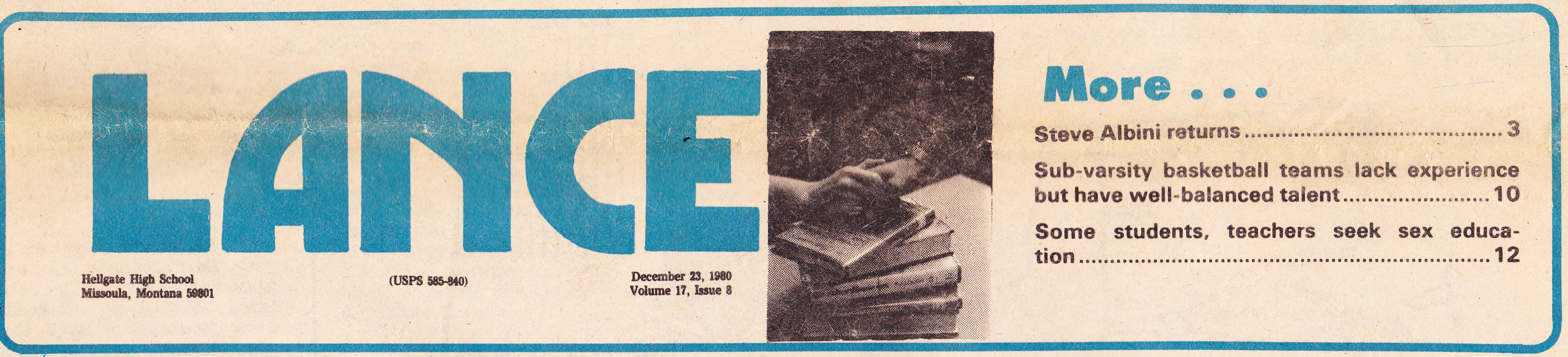
The next time I had a meaningful encounter with Steve was in the fall, after I had started Journalism 1 in the classroom adjacent to the Lance office. At that time the juniors and seniors who made up the staff were still deciding which of the J1 students they could stand being around. The jury was still out on me.

I was sitting in the cafeteria one day, when an assemblage of ruffians grabbed Steve and duct-taped him into a chair. They wrapped tape around his torso and arms and the back of the chair, and taped is legs to the legs of the chair. It was obviously a preplanned attack. They all had a good laugh and walked away. I stood up and walked toward him. He was helpless, and had been left in the middle of the walkway just inside one of the entrances. In other words, people had to walk around him, and they did. To my amazement, nobody helped him.

This was was all due to Steve’s unpopularity throughout the school. And that was due mostly to one column he wrote: a review of a Boston concert, possibly the most popular concert  among teens in Missoula the whole time we were in high school. Steve wrote that the show was was boring, which infuriated Hellgate students who had attended it, and the Lance received angry letters about it for months. Good at arousing anger in mass numbers: check. Good at self defense: no.

Troy Deckert, Lance editor and Steve’s friend, went for help or scissors or something, leaving Steve alone. I walked over to Steve and said, “Want some help?”

“Sure.” He said nothing while I untaped him.

“Thanks,” he said, and walked away.

* * *

The Lance staff, and to lesser degree, J1, were seen by outside students as something of a clique. We denied it, but it was partially true: there was a clique within the journalism classes. I perceived there was an inner circle on the staff, that Steve was in it, and I wanted in. I was hoping to make a good impression.

There was a wall between the office and the classroom. It divided J1 and J2. There were two possible ways for me to get noticed. From the start of the year, we were required to submit critiques of every issue of the Lance. We turned in each issue of the paper, marked up with our comments and corrections. I decided to announce my arrival with my first critique: I filled very bit of white space in the margins and gutters with my somewhat surreal or goofy humor, and some stream-of-consciousness ramblings mostly unrelated to the paper. I drew little cartoons. It was weird. It was me.

The second way to get noticed came later in the year, when we started submitting our assignments for possible publication. But that would have to wait. When our first critiques had been seen by the staff, they were handed back to us. Mine had a note to Mr. Seitz stapled to it.

“Of all the critiques I saw, this is the only one that showed any creativity or original thought. I look forward to seeing what he can contribute. Steve”

That was exactly what I was hoping for, but I didn’t expect to hear back. That it came from Steve elated me.

* * *

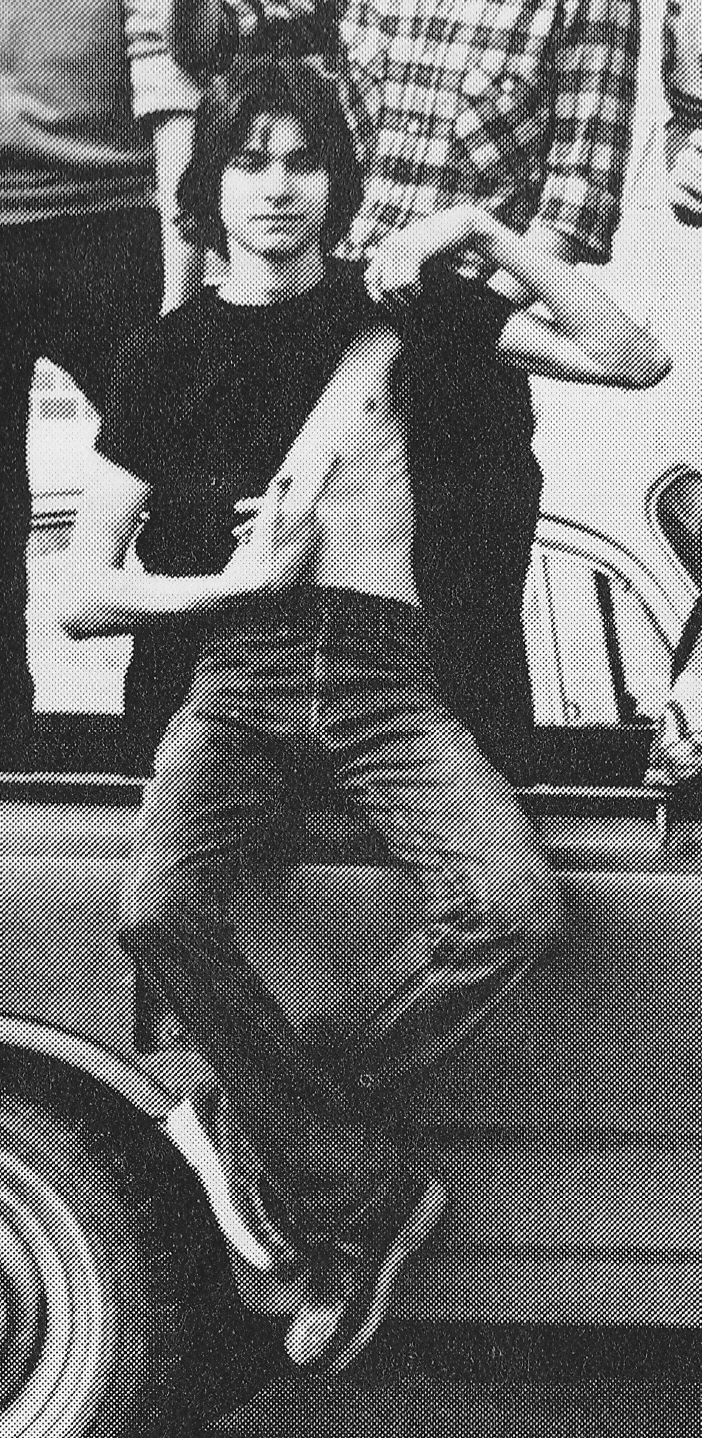
It was Steve’s senior year. In the summer he went to Boy’s State. He was on the Lance, in Drama Club, Student Senate, and Model United Nations; contributed poetry and fiction and photos to the Troubadour; scored as a National Merit Semi-Finalist and was in the Top Twenty of his class. I once saw a research paper he wrote lying around the Lance office. It looked to me like college work. On top of all this, someone in a car smashed his leg when he was on his motorcycle, and he started a punk band. Good at looking good on college applications: check. Time management: check. Making the best of what were probably the worst four years of his life: check.

Unpublished cartoon from Steve’s notebook.

Steve now had a different position on the Lance staff, that of In-Depth Editor. Karen Moulding had taken over as Editorial Page Editor. I think this was a position created for (or by) Steve to give him the latitude to use his eclectic writing and drawing talent. Seriously, Steve was good at everything he did on the paper. He wrote music reviews, in-depth reporting (I especially remember a two-page spread he did on teen suicide), a regular column, and drew cartoons. He called his column Paparazzo. While the term paparazzi had entered the English language, it was not as widely known as it became in the 80s.

“What does Paparazzo mean?” I asked.

He replied, “It’s Italian for an annoying buzzing insect.”

“Oh,” I said, “that’s you.”

I submitted some humor columns, before I had a staff position, under the title Guinea Pig Bones, which derived from a song a friend of mine made up when I was probably ten or eleven. But I decided on a self-referential name like Steve’s and changed it to Nowhere Man.

Toward the end of the school year, J1 students applied for the staff positions they wanted the following year, with a first, second and third choice. I can only remember my first: Editorial Page Editor. The graduating seniors on staff would decide in a closed meeting on staff assignments. My friend Dave Larson, a junior, and I were selected as co-editors of the editorial pages. I was interested in three things: I wanted to write lead editorials and my Nowhere Man column, and draw cartoons.

As the year progressed and I put some of my endeavors forward, my confidence as a writer was developing. But as a cartoonist, I knew I had severe limitations. Steve gave me some basic pointers. He talked to me about pens, what to use for what, how to hold them when drawing. He gave me the idea of using brushes as well. He suggested I use better paper than the typing paper from school I was using. He told me I should practice tone-building patterns (such as cross-hatching) and gave me a sheet with with different patterns to try. Last of all he gave me a couple of books on cartooning technique. One of them was excellent and I kept it for years. I wish I still had it; I’ve never found one that matched it.

I was never a great cartoonist, (in fact, if hurried, my drawing was awful) but all of these things made a noticeable improvement in my drawing and gave me confidence to try new things. I had always been a doodler, and especially liked to make my friends laugh with funny pictures. But I had never gotten more satisfaction from it than I did when I started to do it with a little more skill and assurance.

This was also the first time that I found myself getting anywhere through practice. I quit wrestling during my second season in part because I was defeated in every match but one and wasn’t improving. I started that year with next to zero self-confidence in anything I did. At the same time J1 was pointing me to some stuff I might be good at. Working at something – like drawing or writing – and getting better at it was a small revelation to me.

Steve Albini had talent. But not everyone who has talent develops it and exhibits what they can do in a way that others can see and enjoy and criticize. Some people certainly thought Steve, like a lot of us when we were young, just wanted attention, negative or otherwise. But I don’t think that’s fair. Hellgate High School, like every other, was a hive of teenagers, and who would blame anybody for just hiding out for four years, rather than expose oneself to the hormonal mob? Steve was Steve. Steve was a writer of in-depth reporting, opinion, poetry, short stories and songs. Steve was a photographer, an artist, an actor, a raconteur*, a scholar and a punk rocker. He was being himself. He didn’t hide. Me, I was going to hide, but Steve is the person who gave me the idea of not hiding out for four years, so I didn’t.

(Since then he has shown himself good at other stuff: recording records, giving interviews, poker and cooking, to name just a few.)

Understand, this is not gushing over him. He wasn’t Leonardo da Vinci. He wasn’t my hero, or even a role model. However it does help to explain why I remember so much about him, and why I still appreciate what he meant to me at the time.

* * *

There were times I was annoying or obnoxious. Steve too. There was a time or two I got mad at Steve, and I know I got on his nerves occasionally, but I did consider him a friend. We had a more than a dozen friends in common. We went to a lot of the same parties. We went to see some shows together, including Cheap Trick. I remember sitting next to him when a bunch of us went to see Quadrophenia, and Steve having to explain to me the setting of the movie. We went to The Rocky Horror Picture Show a half-dozen times. On top of that, there were the little gestures I just described. And there are a few other episodes better left unpublished.

But the real mark of friendship in my mind is the Friday night at the beginning of summer that Steve called me up to go catch a movie. He picked me up, we went and saw, from start to finish, one of the most pestilent and egregious movies of all time, and afterward he dropped me home. I suppose it was friendship, or companionship at least — or perhaps it was really just the boredom you experience living in a small Rocky Mountain town while deep in your core the Windy City and the Crash of a Thousand Guitars is calling you by name.

Maybe knowing what the movie was will provide a clue.


part one.   part two.    part three.
_______
*Steve can tell a story, and otherwise verbally engross an audience. To watch a video that perfectly captures his style, then and now, go here.

school days with steve albini. part three.

#3: Do it Yourself, Why Don’t You – Part 2

Last post I talked about visiting Steve Albini a few months after he had produced Lungs, and how the do-it-yourself project influenced my thinking about media access and, in a broader sense, making your own way by making it your own.

Just Ducky

That really started back in high school, when Steve put together his first band, Just Ducky. I don’t have a lot of details about the band, and my chronology is pretty fuzzy. What I do have is a few memories, and some artifacts. They might be the only ones still in existence, and I have the pleasure of sharing them with you here. It includes a steno pad of Steve’s that I used after he did, and then kept all these years. In August I showed it to him, offered to give it back, and asked if I could keep it and use it for these posts. He said, Sure. Again, thanks, Steve.

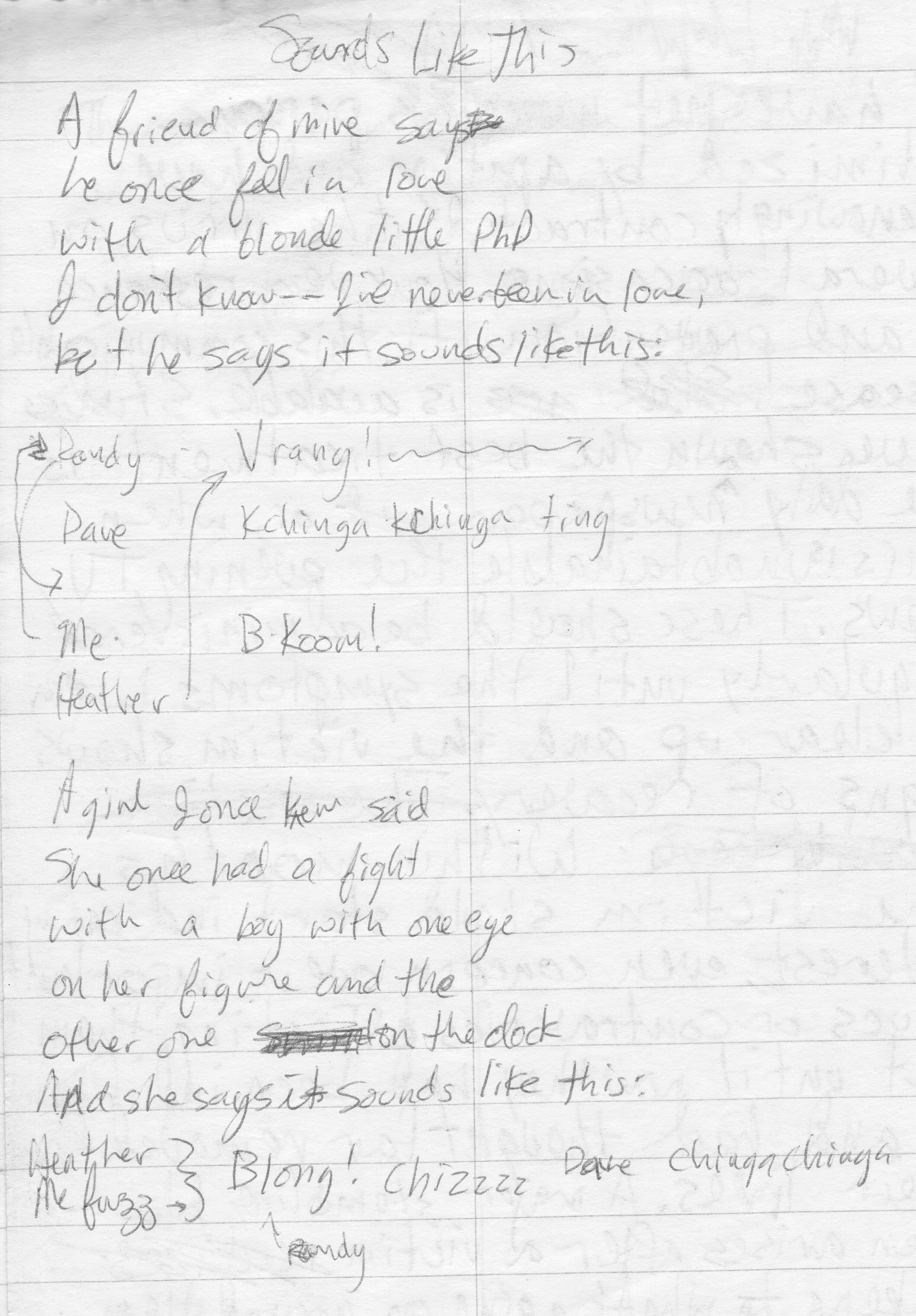
As I said before, I read that Steve taught himself electric bass while laid up with his broken pretzel. I believe that was in the fall of 1979, because he has the cast on in the Lance staff yearbook photo, and I believe that was taken in the fall. My recollection of going to parties through the winter, that were played by Just Ducky, indicates the band was put together in the late fall or early1980. The line-up I remember is: Steve on bass and vocals, Jon Rose on guitar, Heather Gonsior on keyboards. If the Wikipedia article is to be believed, the drummer was Joey Cregg, whose name is familiar, but whom I don’t remember. However, in his notebook, Steve noted on one of his songs (Sounds Like This) parts for “Randy, Dave, Me, Heather.” I have a guess who Dave is, but I don’t for Randy. I wonder if this is the original line-up, and it changed. (Perhaps someone reading this remembers.) Another note seems to list outstanding debts of band members for expenses: “Dave, Steve, Heather, Jon, Randy.”

(Update: Members referred to are Dave Peterman, and Randy Pepprock. See Comments.)

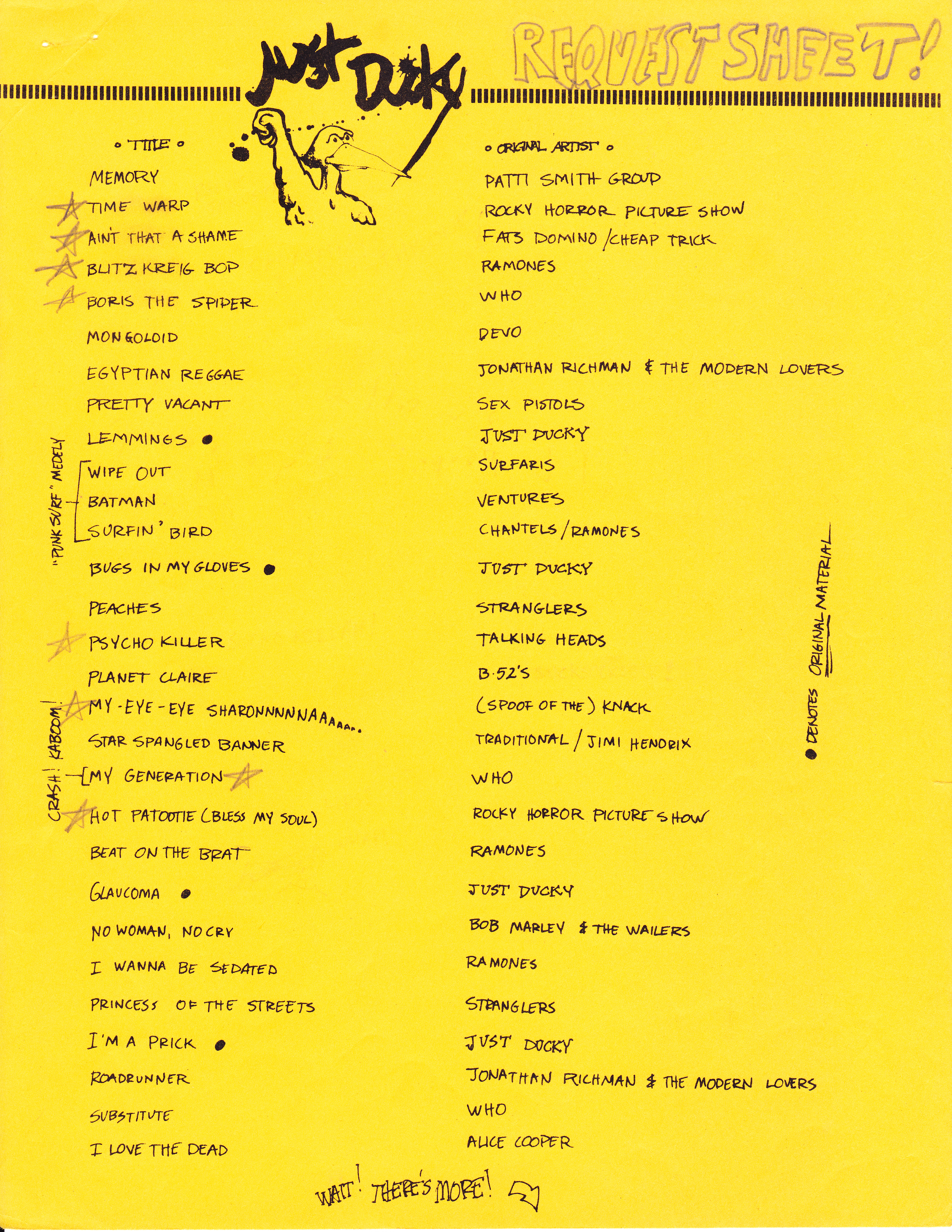
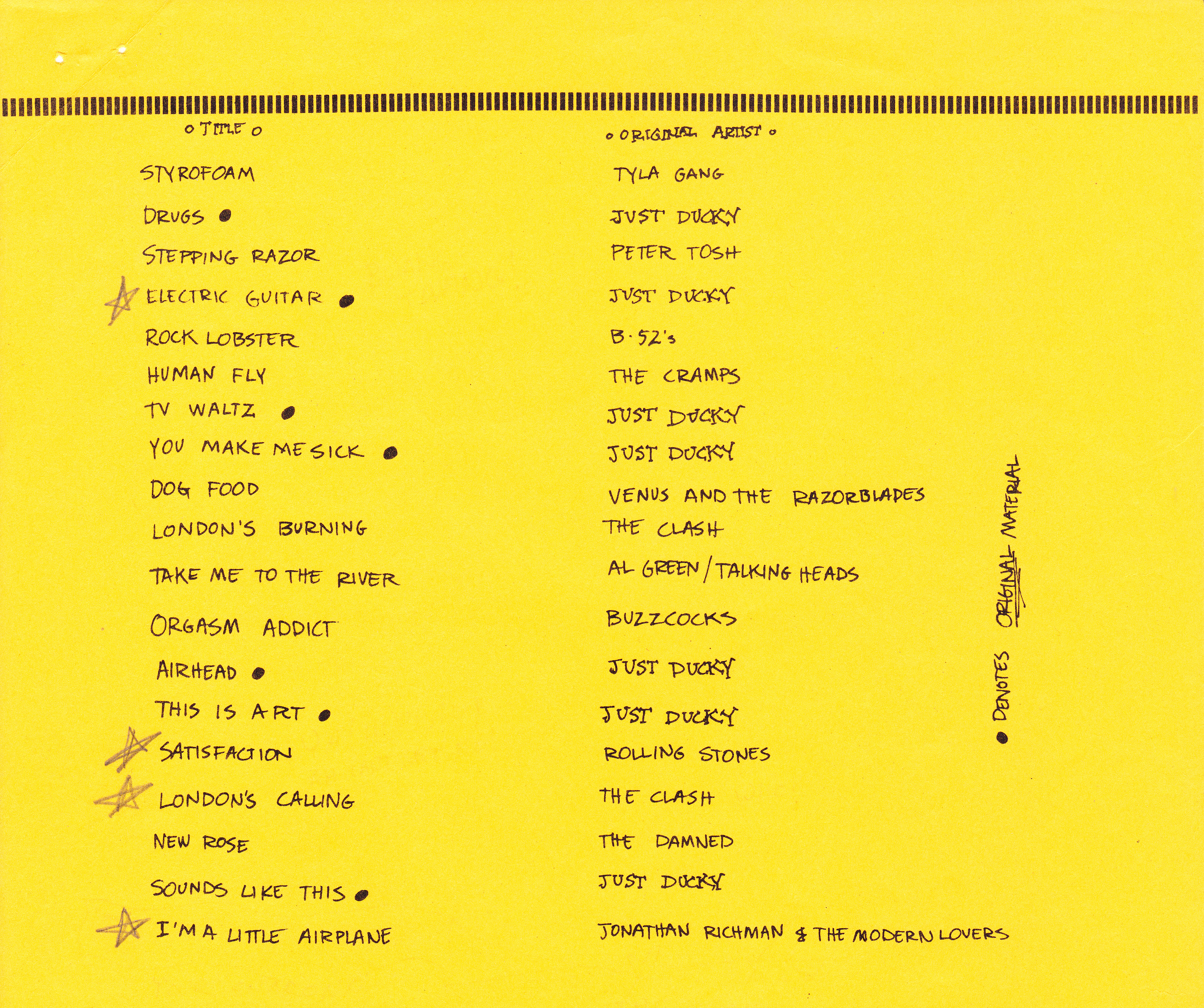
They were a garage band, but they were the first band I knew, and I got a huge kick out of them. Hearing them play – at parties, at local clubs or just rehearsing – coincided with my first exposure to punk and New Wave music, and with having joined a new circle of friends. In fact, the songs I remember were their covers, and some of them I heard for the first time performed by Just Ducky, not the original artist: Blitzkrieg Bop, Psycho Killer, etc. They played with lots of energy and a really big beat. For the most part, they chose infectious and accessible songs. They also put a punk twist on some classics. They made me want to dance, however embarrassingly.

My copy of the band’s song list. I put a star next to my favorites.

I remember them playing a party in the apartment of Steve’s sister Mona, when the band took up half the living room. I remember going to a club (Yes, I was 16, but what can I say? They were lax.) and sitting in the front. They were poorly received and someone lobbed an ashtray at Steve. (Who else? Not Jon or Heather – they were so nice! Just playing their instruments for world peace. But not Steve.). I was worried that Steve might get hurt. To my alarm, he was not worried: he urged the crowd to throw more things at him. I suppose he was also not worried about playing that venue again.

I also remember the end-of-the-world party. Well, I remember we had one. I don’t  specifically recall the event. In the spring there was a small cult in Missoula that predicted the world would end in a nuclear holocaust at 5:55 pm on April 29th, 1980,  so Steve decided we should throw a party that day and call it the Doomsday Party. Musical Apocalypse provided by Just Ducky.

Steve made this flyer.

The band was short-lived. If it began in the fall, it was over no later than the summer. They lasted maybe eight or nine months. Even so, I think it was important to Steve, and he took it seriously. His notebook has some calculations about the purchase of gear and how much it was going to cost, that show he’d done done his homework and thought through their options. I don’t know why he started a band, knowing that it would cease in less than a year. My guess is that everything Steve did was to teach himself how things worked out. The only way to know, to really learn, is to do it yourself. Other people’s experience can be helpful, but it tends to offer lessons rather than the personal skills and know-how you must have. Eventually, you have to move beyond dreaming and planning to actually doing it.

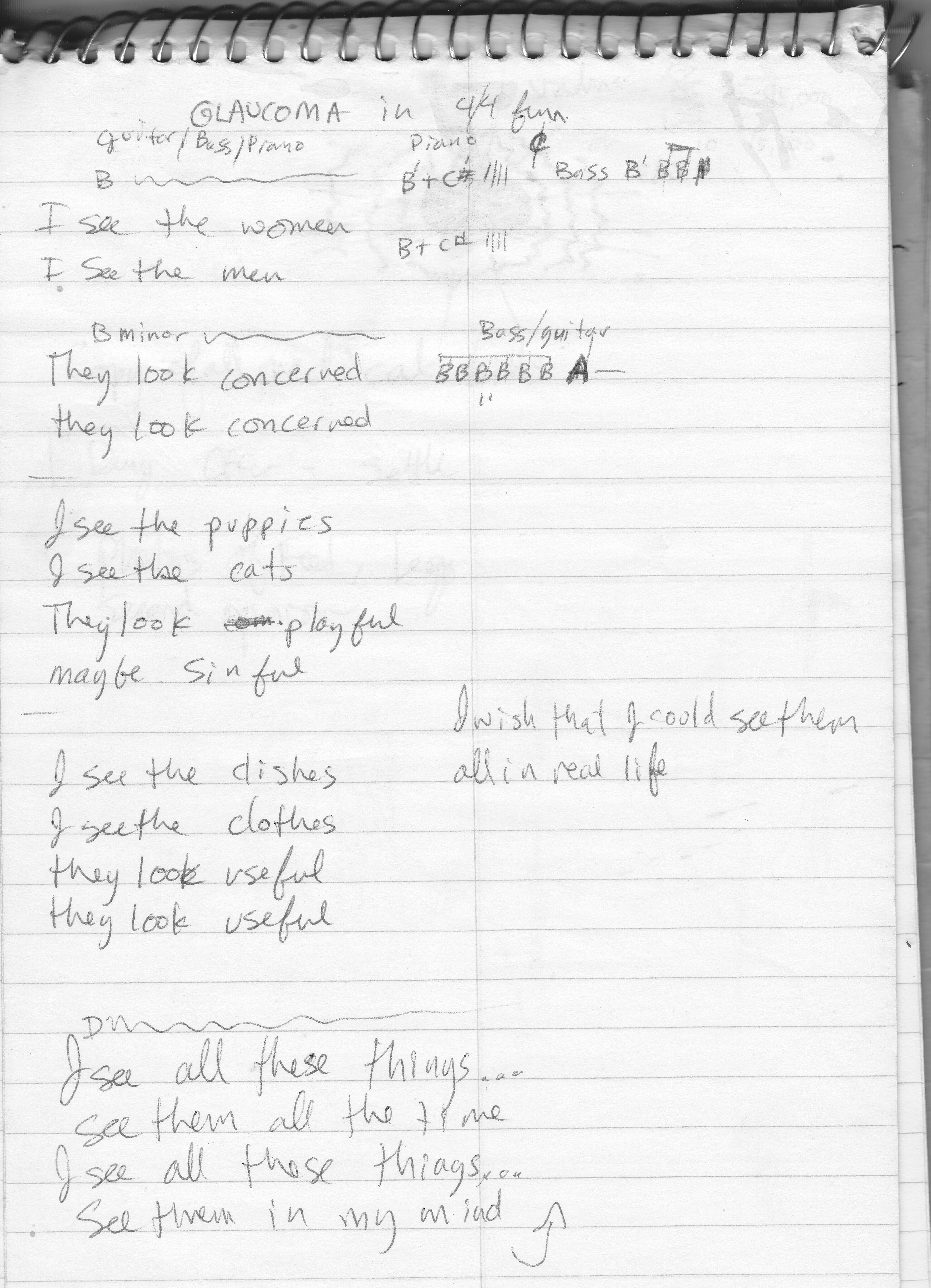
“Glaucoma” by Steve Albini. The thought of someone publishing some of the stuff I wrote when I was 17 mortifies me. That’s why I got Steve’s blanket verbal permission after he looked at the notebook. Even so, I have no desire to embarrass him (Is that possible?), and in my amateur opinion there is nothing embarrassing about these songs. If you were writing rock ‘n’ roll songs when you were 17, then you can criticize, I suppose.

I should say something about Steve’s original songs. I have absolutely no recollection of them. I know they played a song called Glaucoma, and I marked another, Electric Guitar, as a favorite on their song list, but I can’t remember any of them. Glaucoma and Sounds Like This are the two songs preserved in the notebook. To my knowledge, they never recorded anything. It wasn’t that kind of band. For Steve, I think it had mostly to do with learning how and having some fun.

“Sounds Like This” by Steve Albini. Sounds like fun.

Even though some people hated every note they played, a lot of us – mostly friends of the band, and people who knew each other – got a big kick out of them and appreciated Steve’s homegrown punk persona. I never got to see the Ramones live, but Just Ducky, with the 17-year-old pretzel Steve Albini, barking out some of our favorite punk and new wave tunes, was a pretty good stand-in.

Kchinga ting!

Next: #4 Small Gestures.
part one.   part two.    part four.

school days with steve albini. part one.

Back in January of 2007, almost two years before I did it, I was planning to start a blog. I wrote a few things, and one of them I thought I would make my first post was entitled, “Thank Steve Albini for This Blog,” a stupid title on multiple levels. What I wrote there was a few things for which I was grateful to Steve having taught me by word and deed.

I went to high school with Steve, and he was the most interesting and certainly one of the most talented people to walk the halls of Hellgate High School. In fact, Steve is one of the most interesting people I’ve ever known, and that would be true even if he’d been washing windows for the last thirty years. I saw him on a visit to Chicago in 1983, and I did not see or talk to him again until a friend reunion in August of this year.

At one point, at our Friday night party, I told Steve about the unpublished article I wrote. “Since I knew I was going to see you, I decided I would just tell what it said, by way of thanks.”

“For what?”

“That’s what I’m going to tell you.” I explained to him that there were four things I had learned, mostly by his example, that they had stayed with me, and he was the person I had to thank for them.

  1. Maybe you should try something new for a change.
  2. Motorcycles = broken body parts.
  3. Do it yourself, why don’t you.
  4. Share your talent and encourage others.

(In the article there were actually five, but the fifth was more or less an excuse to tell the John Lennon Story, which will have to come later, and it was not something I was thankful for.)

I was glad to be telling this to Steve. Many people help us to grow and change in various ways, and being able to thank someone for it, even when they seem like small things, I think is worthwhile. For his part, Steve Aged 50  was a little surprised I had some nice things to say about Steve Aged 17. Why is that? Well, remember that bit about Steve being the most interesting person, the most talented person? He was also the most hated person.

This was not an accident. In my freshman year, before I met him, I avidly read his columns in the Lance. He wrote music reviews and other articles, but my favorite was his humor column. He also did cartoons and illustrations. He did it a lot. In fact, he made me want to write for the paper. For that, I would have to take Journalism 1 my sophomore year, then I could be on staff my junior and senior years. In his writing Steve was funny, outrageous, and knew how to antagonize people. He also talked about stuff that was not mainstream in Missoula, Montana in 1978. Like punk rock.

Steve could make people mad, and did make people mad, but why did he make people mad? I couldn’t say it was his aim to do it. It was probably closer to the truth that he aimed to say what he pleased, and if that angered his readers, tough. And when it came to saying what he pleased, he was like no other person I had met. Wicked smart and verbally well-armed, he could perforate people or things he didn’t like with his words. But of course, that is one of the few defenses available to scrawny kids who act and draw and write and make music in a setting dominated by conformity to a teenstream culture that didn’t always value someone like Steve.

#1: Maybe you should try something new for a change.

Not caring what other people think was required of someone in a fierce struggle to find and be themselves as a teenager who does not and will not fit in. Pushing back on the pressures we were under to not be ourselves – or at least insisting on being able to explore the possibilities –  took some resolve, and sometimes there was anger or resentment lying beneath the surface. That may have been some of the appeal of punk rock: the ragged edge of anger over the pressure that bore down on young people: you can’t do this, you must do that, and stop complaining because there’s nothing you can do about it. Instead of the Boomers’ demand for a better world, many had the Gen-X resentment at the empty promise of one. Might as well blow off a little steam about it.

Another angle is looking around, like many teenagers, and finding plenty to be disgusted, dismayed and angry at. There was some of that for me. Maybe for Steve, too. I think it’s in his songs.

Of course nothing like this occurred to me at the time. On the contrary, I had been sleep-walking most of my life. And I was much more of a boomer in my general outlook – more hippie than punk – so I found Steve’s recommendation of punk rock hard to grasp. After I met him in the fall of 1979, I would rib him about it, as if he should be embarrassed to embrace and promote music – and the attitude that went with it – that was so far out of the mainstream, that people (like me) were so unlikely to accept.

Steve was annoyed but put up with my pestering. On the one hand, he managed to make me feel like a dork for having such narrow taste in music: I had grown up listening to the Beatles, Elton John and whoever else was played on MOR radio, and didn’t know about much else. I had read about punk rock, but I had never heard it – until I met Steve and the other friends I made on the Lance.

On the other hand, Steve did not just make me feel stupid, he made suggestions to me about music he thought I should listen to. My response was skeptical and dismissive at first. That changed after I had ignored his positive review of Tom Petty’s Damn the Torpedoes, and subsequently heard it. After that, I realized I should reconsider blowing off Steve’s musical opinions. The fact that he put down music I liked (On CSN&Y: “They’re fat and old,” which I later realized he probably got from a line in Remote Control by The Clash.), didn’t mean he couldn’t point me to something great, which is exactly what Torpedoes was: freakin’ great.

From Steve’s notebook.

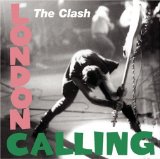
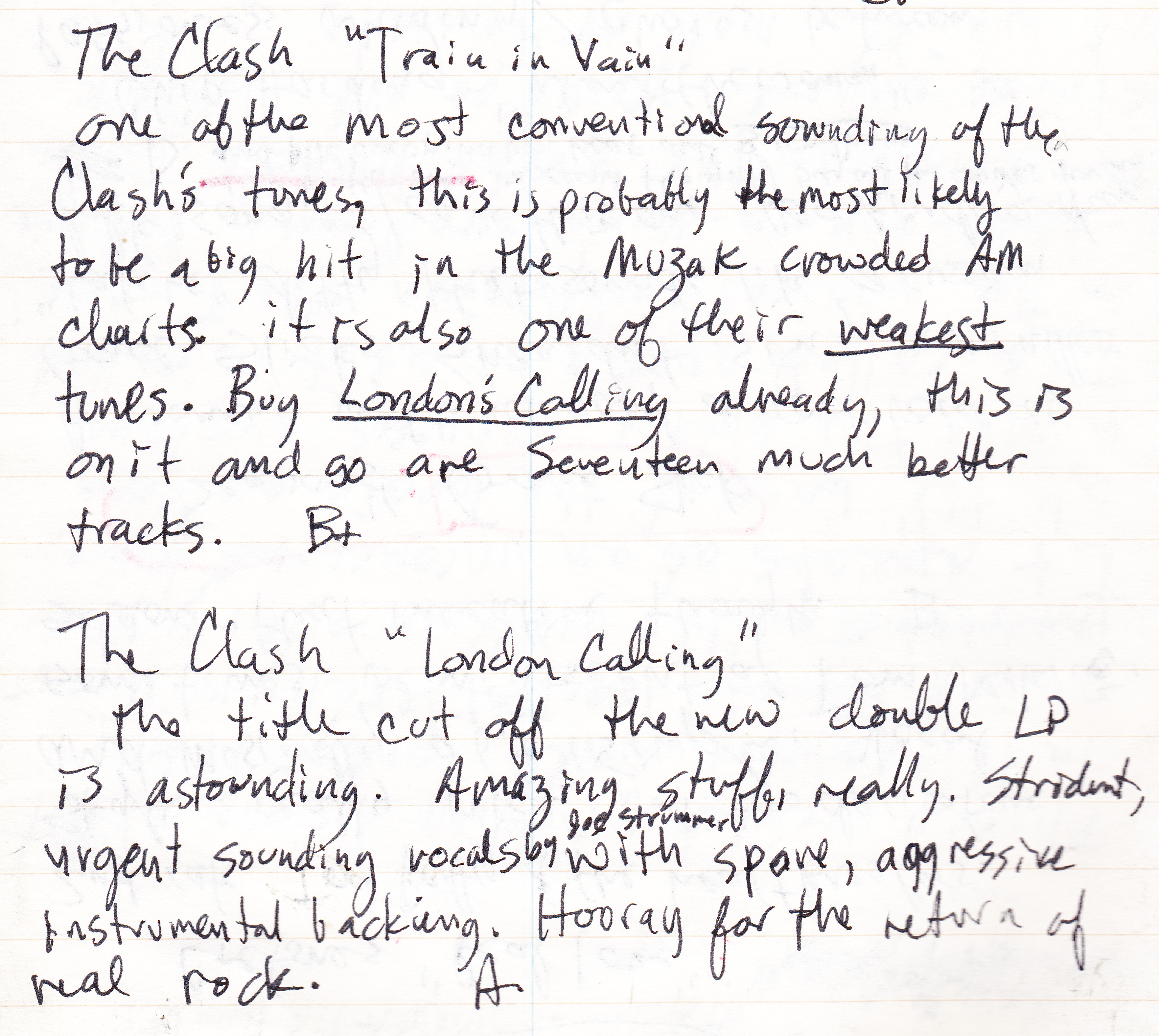
In December or January, Steve included in his song reviews two songs from The Clash’s London Calling. Around the Lance office he was talking up the album. I was skeptical until I heard the title track on a surprisingly eclectic AOR station. I remember today the very time and place that song came booming and screeching through the speakers in our living room.

London calling to the faraway towns
Now war is declared – and battle come down
London calling to the underworld
Come out of the cupboard all you boys and girls

The Clash interrupted my regular programming with a report of nuclear apocalypse, of the world ending with a whimper – a variation on the scenario that had visited me in nightmares since I was ten.

It blew my mind. Then I heard it again. Then Troy Deckert, the editor of the Lance, got the album, and I heard the whole thing. That changed everything. After that, I wanted to hear new things, and what a time for hearing new things that was! The Ramones, Elvis Costello, Warren Zevon, The Pretenders, The Talking Heads, The Police – all putting out music that spun my head. Much of the real excitement I felt at this time in my life was the discovery of new and old music  that I never would have heard if it wasn’t for Steve, and later my other friends (Troy, Jeff Morgan, Matt Crowley, Mark Hayes), who stuck it in front of me.

How the combination of new friends, new music and drugs altered my path is more than I’ll go into here, and it wasn’t all helpful, but having my mind and ears and eyes opened to a wider world of music and ideas was a gift. It was Steve who first put his shoulder to the door and gave a good shove.

Next: Motorcycles and Music.

part two.   part three.   part four.

school days with steve albini. part two.

#2: Motorcycles = Broken Body Parts.

Continuing my account of four things I learned through my short high school friendship with Steve Albini, I come to #2, which does not require much explanation. Steve rode a motorcycle. During his senior year (’79 -’80), Steve got creamed on his motorcycle by a larger motor vehicle. Steve’s leg got snapped like a pretzel. Come to think of it, his legs were pretzels. The straight kind, you know, like Mr. Salty.

Never, since I saw him in his hip-to-heel cast, and heard his account of the accident, have I wanted to own a motorcycle or ride on one going more than 15 miles per hour. That’s just how it is.

Lesson learned. Thanks, Steve.

It actually may have not been his only injury-accident on a bike, but my memory of that is fuzzy now. At least one account of Steve’s high school days says that he taught himself the bass guitar while he was incapacitated. I don’t recall that myself, but it does make a nice segue into #3, which is all about music and life.

#3: Do it Yourself, Why Don’t You.

In Dallas, 1983

In March of 1983, I was living in Oklahoma City, and took a bus up to Chicago. I went up because Troy Deckert was getting married. Mark Hayes was living in Chicago as well, and at the time was staying with Steve. I don’t remember where I slept at night, but it seems we spent considerable time at Steve’s apartment. Steve was in his third year at Northwestern. I recall that when I first got there Steve was out of town.

When he returned he breezed into the apartment, explaining that he, “Just came from Madison, where I got my hair cut by a Neo-Nazi.”

I hadn’t seen him in two and a half years.Time was flying. Steve was flying. He was energetic, enthusiastic, apparently happier than he had been in Missoula. He seemed to have a lot of irons in the fire.

When he got there it was the first time the four of us had been together since December of 1980 in Missoula. That, I may as well add here, is when and where The John Lennon Story fits in.

It was my junior year at Hellgate High School, and I was struggling, academically and personally. One of the things I felt I had going for me was my work on the Lance, where I had Steve’s old position of Editorials Editor. In December, the murder of John Lennon was a real blow to me and several of my friends. We did not talk about it much, mostly I suppose, because we didn’t know what to say. I know I didn’t. It just sucked.

Steve came home to Missoula that week. I ran into him Saturday night at a “New Wave Festival” at the University, and asked him if he would write a guest column for the Lance. I thought it would be funny to see people’s reaction to its appearance when they thought they were finally rid of him for good. He balked at the idea. I pressed him and he relented.

The piece he turned in I felt compelled to publish, but I was the one who was cheesed off by it. There were two reasons. One: the thrust of the column was, “John Lennon is dead and I don’t care.” Two: he included an account of me asking him to write it that had me sounding like a complete dork. If Steve truly did not care what people thought of him, then I was his total opposite. I cared desperately what people thought, and I had pretty thin skin, too. I didn’t stop to think that nobody’s opinion of me would be formed by what he wrote. Some people would have considered it an honor to be called a “notorious hippie” in the same piece that said John Lennon was better off dead. But I felt the column had made of a fool of me, and it hurt my feelings because, even though we weren’t close, I considered Steve a friend – with good reason. At the same time I realized how ridiculous it would seem for me to vent my anger for the same period of time I felt it. I expressed my anger to my friends, who laughed it off, then kept it to myself. It seems to me now that it was Steve’s last chance to give high school the finger. I just happened to be standing in view.

There’s a story our friend Deb Scherer tells, who also served on the Lance. She had a distinctive way of dressing. It was eclectic, it was funky, it was her own. Steve was giving her a hard time about it. This from the guy who came to school in his deliberately shredded pretzel-pants and similarly abused t-shirt on which he had painted in fire-engine red: “DIE!” Deb finally said to him, “I don’t care what you think of the way I dress!,” to which he replied, “Good, you shouldn’t!” Some of the things Steve did and said were undoubtedly expressed with this conviction in mind. Considerable vexation throughout the English-speaking world over the last 30 years could certainly have been avoided if others had shared it.

Matter Magazine, 1983

So, in 1983, that had been the last time I had seen or spoken with Steve. I was over it, but in the intervening years a lot had happened. Steve had heard that I had gone off into the Weirdlands and become a born-again Christian. Even more disconcerting, Troy, who was a closer friend to Steve, had come to Chicago the previous summer and done the same. I suppose you can imagine how completely insane some of our friends thought it was that we would both, at the same time, hundreds of miles apart, come to Jesus. Every time I saw one of my old friends, I expected to be “dealt a ration,” as we used to say. I expected the biggest ration of all to be dealt by Steve. I was waiting for it.

Steve showed me his apartment. The highlight of the tour, from Steve’s viewpoint, was in the kitchen, where he showed me Archie, a really huge and thankfully deceased cockroach. I’ve got to hand it to Steve Albini. Not only did he afford Archie the respect and honor he deserved, but he had enough taste and culture to preserve him for others to enjoy. As I admired the enormous blattoid, Steve said,”So Dehner, why Jesus?”

I was expecting something quite different, so the question caught me off guard, and I fumbled for something to say that would make sense. Actually, it was great question. It was perfectly respectful, and I should have been able to give a coherent answer. But what can I say? It had been nine months. I was nineteen years old. So I said something like, “Because He’s real. I have no doubt that He is…” Something like that.

Historic Reenactment: Not actually Archie.

“Huh.” He shrugged. And that was it. People who don’t know Steve might think, on account of his sometimes, um, forthright way of expressing his views in public, that he’d have given me or Troy a hard time. But regardless of what he might have thought, he had nothing mean or derogatory to say to me. Live and let live seemed more his style. He let a Nazi cut his hair. He let a Jesus freak see his cockroach.

Then Steve showed me a unfurnished bedroom, that had only some musical gear, his electric bass, his drummer Roland, and a box or two of 45rpm EPs.

“This is our record,” he said, pulling one out. “Here, have one.”

It was Big Black’s first record, Lungs. And it wasn’t really “our record,” it was his record. He made it.

No, I mean: he made the record.

He wrote, played and sang (“i’m a steelworker, i kill what I eat”). He engineered, recorded and mixed. He took the photos and created the cover artwork and logo. Wrote the liner notes. Polymerized the vinyl compound with his own chemistry set and hand-etched the grooves in the disk (Actually, I think he might have hired this part out.). Packaged and delivered the records to local stores — with party favors enclosed for the lucky customers, so that opening your Big Black LP was the musical equivalent of Cracker Jacks (if you wouldn’t mind finding a bloody kleenex as your ‘toy surprise’).

The point, that I’ve taken so long to get to, is that he didn’t ask anyone’s permission to make a record, and he didn’t wait for – or even pursue, as far as I know – a recording contract, either. He didn’t have someone looking over his shoulder telling him what he could or couldn’t say. He just made the thing himself. And he told anyone reading the insert to go make their own record, too. It was simply unacceptable to him that he would relinquish the control and freedom to make the music he wanted, and get ripped off in the process.

Using this approach, Steve pretty much made his musical career on his own terms. Further, he inspired others to do the same. This same spirit came to drive not only independent music, but indy film making as well, and made the Internet the ultimate democratized medium.

When I was struggling to make films in the 80s and 90s Steve’s literally homemade record pointed to the possibility of not only by-passing media gate-keepers, but also kicking down the gates. One of the things we talked about in August was the collapse of the recording industry as we’ve known it, and something much better (in Steve’s view) replacing it.

On Lungs, Steve had a friend named John Bohnen play the sax on one of the songs, and gave Mark credit for “more yells on dead billy.” He did everything else. Big Black was about to become a band, and this record helped put it together. But before Big Black was a band, even before Big Black was just Steve and some instruments – there was Just Ducky.

Next: #3 Part 2 – Just Ducky 
part one.   part three.   part four.

From the ‘liner notes’ insert. For the record, ‘Lungs’ was made in 1982, not ’81, as has been mistakenly reported.

Just like we used to do

We shall walk again down along the lane
Down the avenue just like we used to do
With our heads so high smile at the passers by
Then we’ll softly sigh…

Everyone, Van Morrison

This past summer, I had one of the very happiest experiences of my adult life. It confirmed once again that – for myself – along with love and discovery, one of the  paramount joys of living is reunion — meeting friends and loved ones after being separated by time and space.

In August, more than twenty people gathered in Missoula, MT, who were friends at Hellgate High School between 1978 and 1982. One person came who went to Sentinel High. Most but not all of us had worked on the staff of the school newspaper, the Lance. We came from Portland, Seattle, Tucson, Oakland, DC, New York, Juneau and Saudi Arabia. Many of us had not seen each other in over thirty years.

We honored our journalism teacher and Lance advisor, Wayne Seitz, who recently retired. For many of us he was the best, or certainly one of very best teachers we had.

We strolled the streets of Missoula, visited some old hang-outs, and recalled some that are now gone or changed. I remembered skim-boarding the Clark Fork, hiking up Mt. Sentinel to the M, playing pinball and Space Defenders in the University Commons, parties until 2 am, all-night Risk games, putting the Lance “to bed,” walking and driving the eerie, ash-covered town on the night of May 18, 1980, cycling up Pattee Canyon, cresting Strawberry Ridge and looking down on Missoula with its Dome of Smog created by temperature inversion; standing in the warm summer rain, knowing the sun would be out to dry us in a few minutes.

I was struck by how deeply affected I was by living less than three of my 49 years here. I reflected how fortunate I had been, recalling my friends, a few now gone from this world, the cast of characters we saw every day at school, the truly wonderful teachers I had (and a few awful ones), and the best and the worst of being a teenager in what I still regard as a pretty awesome town.

We walked the halls of Hellgate, which were remarkably unchanged. A friend and I got the custodian (also a classmate) to let us into the room that was the Lance office back in the day, and into the old journalism class room.

A few of us went to the Western Montana State fair, and found it just about exactly as it was in the late 70s.

We did a lot of reminiscing, and told a few secrets. I was fascinated to see how we had changed, and how we were the same. Most delightful of all was the proof that no matter how much we may change and grow, our personalities are essentially the same. This reunion came after  doing a lot of blogging, yet to be published, about my teen years. I wondered if I would look back on them differently after seeing the people I spent them with. I think so, but I’m not yet sure how. But seeing them and hearing their voices does make the old times seem fresher in my mind.

I don’t want to leave the impression that I am one of those who consider high school the high point of my life and it’s all been down hill since. That was not in the least true of me, nor do I think it could be said of my friends. It was pretty rough going for a lot of us, and some have few fond memories. But as always, it’s the friends you remember, and who matter.

When I was 16, and I was getting ready to go to a party with my friends, I would get rather excited about it. There was hardly a thing in the world I looked forward to more than spending an evening with these people. And for a few days last summer, I felt the same way. It foretells to me of a day when I am reunited with those I have lost to death: the ultimate reunion. It’s a little taste of the joy to come.

I could hardly contain the joy I felt at seeing and talking to these old friends, some of them very dear to me. In four days I drove the majority of 1200 miles, only slept about 17 hours, yet felt like Iron Man. I probably seemed a little giddy, but not as much as I felt. What a gift it was to have them come together. Thank you, friends.

Save the Date: “Ambrosia” Premieres May 31st

This Thursday marks the premiere of my friend Eric Waetjen’s debut, Ambrosia. Eric’s previous work includes a sharp, polished music video for his band Noir City of their song Cold Eyes, which he directed with (Ambrosia DP) Paul Peterson. (If you look carefully you can spot yours truly at 1:06 and in shots following 1:30)

Cold Eyes displays a clear vision and a developed style that most directors lack starting out. This is due to his talent, high standards and assemblage of talented collaborators. Eric is also a close student of film, staking out personal favorites such Sergio Leone and Michael Mann as sources of inspiration and influence.

I am excited about seeing Ambrosia, which Eric has written produced and directed. With it, Eric presents the kind of narrative he has envisioned almost since we met in 1997: a sci-fi crime thriller with a clean, urban, neo-noir vibe, taut action and lots of energy. Check out the trailers. I think you’ll agree that it looks to be an impressive debut short, with only better things to come.

And if you live in the Portland area, come see Ambrosia. It starts every 20 minutes from 7:30 to10:40 at the Living Room Theater, 341 SW 10th Ave. Here are the details from the Ambrosia Facebook page:

Ambrosia showing on 3 screens, 39 mins, 8 showings
Theater 1: 7:30, 8:50, 10:10
Theater 2: 7:50, 9:10, 10:40
Theater 3: 8:10, 9:30

Come see one of the most intense action packed films produced in Portland (all local actors and crew). All of your friends are invited (free). Please share this event on FB and Twitter with all your friends.
(no minors). Enjoy the bar and café.

THE OFFICIAL AFTER PARTY AT AURA
After you see Ambrosia at the Living Room Theater on May 31st feel free to head just around the corner to Aura(1022 West Burnside Street) for The Ambrosia After Screening Party! Enjoy drinks and DJ music. The door is free!

Questions contact us at intrinsicpdx@gmail.com
Don’t forget to like our page: www.facebook.com/AmbrosiaFilm/

My Nana, my Home, my Hero, my Haystack.

Yesterday my wife and I visited the Portland Art Museum. One of the exhibits is a patron-participation collection called Object Stories. Laura told me that we could bring an object and contribute to the collection, so I brought an item I have had for many years, and told its story. To document the object story, I sat in a booth and spoke while an audio recording was made. Then some photos were snapped of me and my object. In about a week my story will join the many others already recorded and on display there and online. (Update: my Object Story is now here.)

I brought a bottle half-filled with sand. Here is the story.

Sometime in 1976 or 1977, my grandmother, whom we always called Nana, had a collection of antique glass bottles.  I don’t think she had collected them; they came to her, if I remember correctly , together and uncleaned. She let me have one that she knew I was interested in. It was made of clear glass, about four inches high. It had been a bottle of battery oil – Thomas Edison Battery Oil.

Edison was a childhood hero, a man whose genius, creativity, scientific mind and brilliant inventions inspired me and made me want to grow up to be an inventor. At least, when I was eight. His signature was formed in relief vertically on the bottle: Thomas A. Edison.

A year or two later I moved away. In the summer of 1978, I moved to Montana, and later in the summer came back to Oregon, where my family spent a week at the coast. I brought the bottle. About to turn 15, I knew I was closing the chapter of my childhood in Oregon, and wanted to bring a piece of it with me to my new home. So I went down to the beach one day, scooped up some sand, put it in the bottle and stopped it with a wine cork. I took it back to Montana with me, and except for a short period here or there, I’ve had it with me ever since. For 34 years.

I chose the coastal sand over some Portland clay because the ocean beach was special to me, especially Cannon Beach and Haystack Rock where I often went as a boy. So I didn’t need a moment’s thought when choosing the object for my story. This little bottle with its fourfold precious meanings – a gift from Nana, the name of a childhood hero, a piece of home and a remembrance of boyhood summer days at the ocean – came instantly to mind.

Mobs | Part Two

Previously on The Free Range: I have had two opportunities to witness street mobs in action, from formation to mayhem to dispersion. The experiences didn’t provide me much in the way of insight. But did they did make an enormous impression on me, and confirm for me what is commonly understood of mob psychology.

Yoyogi-A-Go-Go

Almost exactly ten years after the Seattle Market melee, I found myself in another mob. In May, 1991 I was in Tokyo’s Yoyogi Park with my sister Julie. In this case, no riot ensued, and no one got hurt, but the frightening character of the mob was on display.

Yoyogi Park on any Sunday: just wonderful and bizarre and brilliant. If you ever have the good fortune of visiting Tokyo, stay through Sunday so you can go to Harajuku and walk through Yoyogi Park. There you will see a delightful cultural menagerie,  uniquely Japanese, swirling with cross currents of Asian, American and European influence and participation. And it must be one of the best places for people-watching in the world.

After we had walked through most of the Park and were heading back out, we came to group of a few hundred Iran-jin. They were guest-workers, all young men who were standing together, talking and dancing. The mood was festive, there was music playing, and their street-party spirit was infectious.

Three Amerika-jin, a couple of guys and one young woman, were there as well. They had been drinking. They had not been trained in cross-cultural competency. The woman started dancing, as if she were merely joining in the fun. But she was not. She quickly seized the attention of a great many of these bachelor strangers in a strange land. What she thought about her dancing, and what the men thought about it, were two wildly different things. I can’t say what was in their minds, but as I said in my previous post, in a mob there is nothing in the mind at all.

The happy Iran-jin as we found them.

The woman soon found herself the center of attention and, cheered on by the excited crowd, kept her up beer-fueled dance party. Now she was encircled, and the shouting and cheering was all around her. “Woo-hoo! Look at me!”

Yes, we are all looking at you. Is that all you’re going to do? Isn’t there something more? The crowd closed together and in on her and her friends. I believed they were hoping that she would shed some clothing. American women do that, don’t they? But what they wanted was hard to discern.

The Amerika-jin decided that the crowd was crowding them and the men began trying to get them to back off a little. They did not. The woman stopped dancing and her smile turned to fear. Now all of them were trying to push the crowd back and get away. The enthusiasm of the crowd was high, though, and they wanted the show to resume. No, really! We want you to dance some more! I think it was pretty important to them.

To start dancing like that, and after you have stoked the interest of the men, then to just stop – well, it wasn’t playing well. Her friends started shoving the crowd back and shouting furiously at them to let them go their way. Afraid and angry, they had to back their way out of the mob.

Fortunately, it it did not escalate beyond mobbing and trying to touch the woman. They  were able to get away. Though it took a while before the mob realized Salome and her friends were gone, when they did, the crowd spread out out as they had been when we arrived.

It was only a close call, more or less a mis-communication between cultures. With a mob, you can’t explain, “I was just dancing because everyone else was. We do that in America, men and women together. I’m not a stripper.” It’s that much harder if they don’t speak your language.

The scene  impressed on me just how fast things can change in a crowd, and how they can spin out of control when people don’t understand each other.

These two experiences have convinced me that there is only one wise course if I am in a crowd that turns into a mob: Hanarere.

Mobs | Part One

Warning: strong language, violence and communism.

I have a special disdain for and fear of mobs and the irrational behavior they engender, especially violence. It is not a phobia, it’s more like the healthy fear you should have of the lion’s den.  Outside: ooh look, a lion. Inside: yikes-a-hooty.

I have had two opportunities to witness street mobs in action, from formation to mayhem to dispersion. The experiences didn’t provide me much in the way of insight. But did they did make an enormous impression on me, and confirm for me what is commonly understood of mob psychology.

Marketplace of Ideas

The first incident happened on May 2, 1981, shortly after I had moved to Seattle from Missoula, Montana. I had a Saturday off from my new job at the cinema, and walked down to the Pike Place Market. It was a clear, cool, sunny day.  At the entrance to the Market, at 1st and Pike, there was a small group of demonstrators from the Revolutionary Communist Party. I knew the RCP. They were very active in Seattle. They were serious communists, who called for the violent overthrow of the US Government by the end of the 80s. They meant to wage all-out war on American soil, killing everyone who opposed their violent imposition of a Worker’s Paradise.The American Communists were lame. The Chinese and the Soviets were pikers. The RCP were going to really crack a few eggs.

But, for today, this was a peaceful group of maybe fifteen comrades, more than half of them women, in their twenties and thirties. They had their red flags, Revolutionary Worker newspapers , and a bullhorn. I walked past them, past a man on the sidewalk playing a flute, past the florist into the Left Bank Bookstore, with its door propped open.

The scene of the riot today

After I browsed for about ten minutes, I heard one of the partisans start up on the bullhorn. I walked over to the door.

“Listen up, America! Your time of complacency is coming to an end! The working people will no longer tolerate the oppression by the ruling class! The bourgeois Reagan regime will not survive the coming upheaval!”

I walked out the door to listen. My complacency was already over. It had been, for two years. The man with the flute played on.  Some other people stopped to listen. The speaker gathered some steam. He quoted Marx, from the Manifesto, nothing to lose but their chains, blah, blah, blah, and then handed the bullhorn off to an African-American comrade. He brought the anger. More people gathered as he rained the wrath of the proletariat on the heads of the dirty, racist, honky capitalists who were going to die in the Revolution.

Understand: I was sympathetic to my communist brothers and sisters. But I was strictly for non-violence. I winced at the thought of a revolution by force of arms. Any sensible person knows that’s a dead end, especially in a country that provides for the peaceful change in government.

The crowd began to feed some of that anger back to the RCP. I don’t think it mattered much who these demonstrators were. Their message was angrily anti-American, and the growing crowd didn’t like it. I was close enough to see their faces, and the partisans were sorry they had let this guy on the bullhorn. Someone took it back, as the crowd grew more hostile.

“Hey, listen. Don’t let us do all the talking. I know there’s a lot of people who have a different point of view—“

“Damn right, commie $#@?!”

“Okay. So the horn’s all yours. Come over here and speak your mind.”

Too late for that, Phil Donahue.

“We want an exchange of ideas here, not a shouting match.”

Yeah, violent revolutions are all about exchanging ideas.

Across the street was the legendary 52 Donuts, a grubby, yellowed cafe peopled by lost boys and hoods. They all emptied out, joined the mob, and immediately became the most hostile and violent people on the street. After all, how could you could pass up a little ultraviolence, especially when you’re in a mob? And mobs don’t get arrested until the cops show up — by then the mob is no more. But now, there was crowd of about two to three hundred people.

Here’s some advice from a former radical. If your rhetoric for overthrowing the oppressive capitalist system evokes anger and violence from street kids at 52 Donuts – scroungers, thieves, pan-handlers and hustlers – it’s time to furl your red flags and call it a day. If the struggling masses want to break your head on the pavement, they probably can’t  be counted on to break bourgeois heads at your request.

Well, you know
We all want to change the world
But when you talk about destruction
Don’t you know that you can count me out
-The Beatles
Revolution

Yep, it turned out the street kids loved America, and not the Revolution. The following year I wrote about this incident for a composition class.

The people (in the crowd) hurled their worst insults at them, and they retorted with Marxist-Leninist doctrine. Then the violence broke forth. It began when a few people went into the Market and bought some vegetables (and eggs), which they threw at the communists as the crowd cheered.

“Hey! Why are you afraid to talk? If you disagree with us, get up here and we’ll have a debate like civilized human beings!”

At the time the irony was lost on me of a group that wanted a peaceful environment to launch a violent struggle in which thousands if not millions of their fellow citizens would be slaughtered. I have since learned this is in keeping with RCP strategy to remain safely on the right side of the law, until the day arrives they can oversee their revolutionary bloodbath.

With that, the speaker received a raw egg squarely in an open eye with such force that his eye started bleeding. At that point I was standing about ten feet away. I knew that staying in that particular spot might soon became dangerous, but I couldn’t persuade myself to leave. Part of it was the excitement…

Then a man, mid-twenties, appeared at my side, said he was a reporter and started interviewing me. I told him how it started. The crowd was pushing in, pressing more tightly around the demonstrators. There was no pushing my way out now. I was in it.

Our talk was interrupted by some confusion behind us. I heard the rattling of the chain-link fence that encased the market newsstand. A tall young man scurried up it and climbed onto the roof. After shouting and whistling, he got everyone’s attention.

“Okay, everybody, listen up! This whole situation is goddamn ridiculous! It’s stupid, and it should stop right now. These people out here – now, I don’t happen to agree with them personally. But dammit, they got a right to be here and have their say.”

A few cheers.

“I think you’re all a bunch of cowards if you don’t have the guts to talk to them like they want. (Booing now) And this bullshit of throwing stuff just shows what chickenshits you are! Now knock it off!”

Some scattered cheers, but mostly anger still. His effort to elevate the discourse didn’t help, other than indicating that, like me, not everyone there was with the mob.The crowd was now a mix of bystanders, trouble-makers looking for a fight, and some persons who would defend the demonstrators, either peacefully or by obliging the trouble-makers with a fight.

People armed themselves. They took the flags from the communists and used the sticks to batter them. They grabbed the newspapers and made a pile with them and the flags and started a bonfire in the street. I saw a young woman being kicked and beaten with a flag pole by a 10 year old kid. The other women had their hair pulled, were slapped, kicked and pushed down. The sticks were broken to give them sharp ends…

Fists started to fly. The reporter and I put ourselves between as many people as we could (holding our arms out and pressing backwards against the mob) to prevent fights. There was little we could do. It was becoming a riot…

There was sheer mass confusion. Shouting, flying objects, fist fights, and the whole crowd pressing closer to the center. Finally the the communists were completely pressed in… and were forced to start retreating. Then the cops arrived, about six or seven of them. They forced their way through the crowd, breaking up fights.

I don’t think I’ve mentioned the blood. There was blood.

One cop broke up a fight and one of the fighters tried to grab him. He got a serious thwacking across his thigh.

“Hey, we saw that!” someone yelled. “Somebody get his badge number!”

“Don’t worry, I got it!” yelled someone else.

(Side note: The police broke up the melee when the communists were utterly hemmed in, kept it from getting worse, and made possible their retreat. Red Papers 4 (1970), part of the RCP’s founding manifesto, advocates and celebrates the murder of police officers at every opportunity. Yeah, you’re welcome, comrades.)

The crowd began to withdraw toward the street again, and disperse, while the demonstrators ran into the Market. I helped a woman off the ground and told to her to beat it – as her brave brothers already had. I stayed until the place was completely cleared. The man playing the flute was gone. The pavement was littered with produce, eggs, and pages from the Worker newspapers. I picked one up, smeared with egg, and kept it.
When I wrote about this in 1982, I saw the episode as a defeat of American values (freedoms of speech and peaceable assembly) at the hands of thuggish American patriotism. I thought the mob should have known they were stepping on rights which were central to our national greatness. But I didn’t consider that mobs don’t know anything. They don’t think. Now I look at the incident more as the confused collision of bored and violent kids feeling the resurgent national pride ushered in by the new president (along with the release of the hostages from Iran and the first space shuttle launch), with incendiary, strident America-hatred – all mashed into the forward, unthinking, unfeeling momentum of a street mob: which more than anything acts likes a mindless, furious lunatic.

Next: Mobs | Part Two

A free flag! Already the Party pours its blessings on a grateful proletarian.

Because of Easter

Because of Easter morning
I know that Jesus can give me what he promised
I know that death is not the end, and the grave cannot hold me
I know that life here is only the beginning, a very short beginning
I know that my sufferings here are brief compared to an eternity of love and communion

Because of Easter morning
I know this life is a vapor and death a momentary passage
I know I will see my loved ones again who are waiting for the Great Reunion
I know I will see and hold my son again –
and I know it will seem as though a mere few moments parted us

Because of Easter morning
I know every vestige of fear and destruction and evil is swallowed up
I know nothing can separate me from the love of God that lives in Jesus
I know the Spirit that brought back Jesus will also bring me back
on that Great Day

We found the stone rolled away and the final reel missing

From the Manger to the Cross (1912)

Despite being made ten years later, it seems fitting to compare this movie with The Life and Passion of Jesus Christ (1902-05). Both early silent Jesus movies, they are also both offered to current viewers on the same DVD and likely to be seen by the same audience.

From the Manger to the Cross is an important movie, apart from its subject matter. It was was made on a large budget, was a huge commercial success and was selected in 1998 by the Library of Congress for preservation in its National Film Registry. Director Sidney Olcott was praised as the greatest film director working.

Sidney Olcott 1873-1946

Watching Manger shows how fast the art and craft of cinema was developing in its early days. In most respects this careful American production, shot on location in Palestine, is superior to its French predecessor. The acting is much improved, and in place of theatrical sets and costumes,  locations, costumes and extras lend more authenticity to the experience. It has more of a narrative flow to it, using intertitles that include dialogue and quotes form the King James Version setting up each scene.

It is a more sober telling of the story. The pace is relaxed. The special effects take a back seat to the realism of the setting and performances. Though the camera does not move, the actors freely within the space, and different angles are sometimes used. The composition and blocking are much more sophisticated.

Gene Gauntier 1885-1966

Two of the performances should be noted. Mary the mother of Jesus is an older, down to earth woman, far from overwhelmed by the burden she has received. There is a fascinating scene that I think I have figured out.  In Nazareth, Mary and Jesus, age 12, are sitting together just outside Joseph’s shop. While Joseph seems to be fumbling with his work, Mary is holding up a scroll, presumably of the Scriptures, and they are reading and discussing it together. It is not clear who is learning from whom; perhaps they are learning together. Is this a suffragette Mary? Given the era, this seems a remarkable insertion into a fairly spare retelling.

I wondered about this until I recalled that Mary is played by the remarkable film pioneer Gene Gauntier – actress, director and screenwriter – who also wrote the script for this film. I believe that, like the renaissance masters, she has painted herself into the picture: a student of Scripture, sitting with Jesus.

Then there is Jesus. Robert Henderson-Bland has given us a better performance , with greater emotional range, including smiling here and grieving there. But  other choices make Jesus out to be a pretty cool customer at times. He puts on a nonchalance, turning away from amazed onlookers after a miracle as if t’were no big deal. After turning the water into wine, he saunters back to his seat. “Yeah, that’s how I party, folks.”

There are little flourishes and details that are interesting and unexpected. The last supper shows everyone actually reclining rather than sitting, and Jesus is shown carrying a tau cross – both indications Gauntier did her research. Mary of Bethany has the most delightful look of pleasure when Jesus admonishes her sister. The priests are particularly wicked, laughing out loud at Judas when he throws the money down and runs away in remorse. The passion is very violent, bloody even. It must have been genuinely intense viewing for a 1912 audience. The mockery and other abuse is ugly, as it should be. The crucifixion is realistic and beautifully shot.

The most stunning surprise of this movie shouldn’t have surprised me at all, because it’s in the title. When Jesus dies on the cross, the story ends. Intertitle with John 3:16. Roll credits. Movie over.

Wow. When they said from the manger to the cross, that’s just what they meant. No burial, no garden tomb, no resurrection. Yes, I was – and am – very surprised that a movie made for American audiences in 1912 ends with a dead Jesus.

If you were planning your Easter to include a Jesus movie, you should skip this one.

Animated Icon

The Life and Passion of Jesus Christ
(La Vie et la Passion de Jésus Christ) (1902-5)

I have intended for some time to post short reviews of the major Jesus biopics, so here goes. There are many more films in this class than you or I would have access to, so I am limiting myself to those that are available on Netflix. You may be able to find more if you seek out DVDs for sale. Many more are discussed at Matt Page’s Bible Films Blog.

It seems superfluous to comment on a movie for you, when you can sample it or view it in its entirety for yourself by clicking your mouse. Nevertheless, I have a few thoughts.

The Life and Passion
is an early and primitive movie, but one made by the best producers in the world at that time, Pathé Frères of Paris. It was originally made in 1902, then scenes were added until it took its final form in 1905. You can now find an amazingly well preserved print of this 44-minute feature superbly transferred to DVD. On the same disc they’ve included 1912’s From the Manger to the Cross, which I will review shortly.

This was a popular film, lively, colorful and Catholic in its point of view. It used elaborate if not convincing sets and costumes, and employed the best of special effects at the time, including the pain-staking process of hand-tinting: adding colors to the picture by painting them directly onto the black and white print, frame by frame. The film deserves some respect for the care, creativity and energy the cast and crew put into it.

Hardly anyone watches silent films anymore. As it would be hard to find anyone younger than myself (born 1963) who grew up with easy access to them (even though they are even easier to find now, on DVD), mine may be the last generation that watched and enjoyed them. I started with Chaplin around age nine, then Lon Chaney and Buster Keaton, and as I got older, added Griffith, Murnau and Lang. To appreciate them calls for a suspension of current standards in acting and film-making technique. You need to see them for what they were at the time, given the limitations they worked under. Do that, and you will marvel at the genius, artistry, innovation, unbridled creativity and sheer insanity some of these brilliant pioneers gave to the world. To this day, people are still watching and enjoying Murnau’s Sunrise and Nosferatu, Lang’s Metropolis and Chaplin’s City Lights.

At the same time, I don’t expect the average viewer today is going to enjoy most of early cinema’s lesser achievements. The Life and the Passion would probably fall into this category: it is technically marvelous for its time, but undeveloped in its story-telling and old-fashioned in its performances. When you see what was being produced in the mid-to-late 1920s, the turn of the century films are rightly deemed primitive. The camera might pan, but it doesn’t move (see the Nazareth scene). There are no close-ups. There is no montage, not even simple cross-cutting. In fact, there are no separate shots, only one master shot. (The year 1903 saw most of those innovations for the first time in Edwin Porter’s Life of an American Fireman and The Great Train Robbery.)

With that in mind, I offer some comments for the modern viewer.

The Baptism of Jesus

Even with the kinetic energy and technical flourishes, it’s a little hard to look past the essential goofiness of this film. Through 21st century eyes it most resembles a Nativity pageant at the corner church, albeit with spectacular stagecraft. Shot in a series of tableaux scenes, there is no real narrative thread to connect them, so it it doesn’t flow or connect. “Scenes from the Life of Christ” might have been a better title. The intertitles identify each scene, but there are none that explain the action or provide dialogue. If you are not familiar with any of the stories portrayed, you are unlikely to have any idea what is happening in them. Possibly for the original, more biblically-literate audience, this was not much of a problem, since at that time the entertainment value was inherent any moving image. Add the spectacle, the miracles, real babies for the Slaughter of the Innocents, the appearance of Jesus, and well, you’ve got a happy audience.

In this early effort some of the challenges, solutions and failings of later Jesus movies are already presenting themselves. Here the legend of Veronica is used, found in Catholic tradition but not in the gospel narratives. Also, we find the conflation of stories, presumably for economy’s sake – an acceptable but potentially confusing adaptation (see this at 21:23 in the video below). Good Friday is bloodless, until  Jesus is “pierced” (actually tapped with a stick dipped in fake blood) by the centurion: the scourging (at 32:05) consists of Jesus being lashed with silk scarves for 11 seconds.

"That's what Christmas is all about, Charlie Brown."

Let’s talk about Jesus. One of my keenest interests in Jesus movies is the portrayal each offers of Jesus himself, a role that poses serious challenges for the best of actors. I will have more to say about this in later reviews. For now, let me speculate that this actor (I haven’t been able to discover his name) was given a free hand in developing a physical presence in this film. In fact, the performances of both the 12 year old  Jesus and the adult Jesus  suggest the actors were having a lot of fun playing him. A little too much fun, perhaps. Not that he is merry. No, he is grand. Instead of being humble and unassuming, he sweeps through the scenes, with big, “Hey, look at me” gestures, waving his arms, lecturing everyone with his index finger, and making a big deal whenever his attention is turned heavenward. At least once it appears that he points at the ground as if he were telling the Samaritan woman to kneel before him (at 18:42; Jesus allowed people to worship him, but he never told them to.). This Jesus looks like the aging proprietor of a head shop or a roadie for the Grateful Dead, but he acts like a low-level bureaucrat that just got made king of the world.

So even with the stagey acting and frenetic pace that quickens to almost farcical speed as it winds up to its climax (The Ascension: It’s spectacular, but it ill-advisedly shows God the Father as a grey-haired old man, ala Gary Larson’s The Far Side);  its flat, fake scenery; its lack of continuity; even with all that, I must choose the portrayal of a show-boating Jesus (“Everybody watch me turn this water into wine!”) as the most serious flaw in this movie. Their first task was to tell a good story, but 110 years ago the conventions of doing that on film were not yet established, so I won’t hold them to that standard. But I will fault them for a hammy, grandiose Jesus who gesticulates but never connects with another person. How could you read any of the gospels and not at least observe the deeply personal connection he makes with everyone who approaches him? There’s nothing even remotely like that here. He is an eccentrically animated icon, nothing more.

This points to one of the supreme challenges for the makers of a Jesus movie: how to bring him to life. Knowing him would seem to be absolutely necessary for the attempt, or at least a genuine sense that one knows him – as a writer, as a director, and as an actor must know their subject. Some actors have been honest enough to say that they struggled with how to play him. Other filmmakers have brought something running the spectrum from admiration to love for him. But it is almost a sure bet that the cultural perspectives of the time will have a lot to do with the image of Jesus. In this case a traditional, French Catholic image, as presented by a studio rather fixed on the business of entertainment and on technological innovation, peopled by creative entrepreneurs and artists. “Let’s make a Jesus movie! Oui! Angels! Stars! Miracles!”

But enough of my opinion (or had that already crossed your mind?) – Watch it for yourself. And just for fun, see if you can find the completely weird placement of the Pathé rooster in almost every scene.

2011 in review

The WordPress.com stats helper monkeys prepared a 2011 annual report for this blog. I had 2600 views for the year, even though I offered only eight new posts. If you were one of my visitors this past year, thank you and Happy New Year! I hope to post more frequently in 2012, so I hope you’ll check back. Also,  I love getting comments!

Here’s an excerpt:

A San Francisco cable car holds 60 people. This blog was viewed about 2,600 times in 2011. If it were a cable car, it would take about 43 trips to carry that many people.

Click here to see the complete report.

The Hiddenness of God

Why is God unseen? Yesterday I read a passage by Gerald May,  a psychiatrist and teacher, on why God is not fully manifest to us in this life. In his book, “Addiction and Grace,” he holds some views I do not, but in other places, he writes beautifully on human freedom and how the grace of God is the only means of being released from our attachments. The thought is familiar, but he says it so well.

Most of the time, God remains somewhat hidden from us. Why? For one thing, God in immanence is already too close to us, too intimate, too much at one with us to be a clear-cut object, and God in His transcendance is too great to be apprehended (Exodus 33:20).

More importantly, however, I think Paul’s words about the unknown God indicate another reason for God’s hiddenness; full and freely chosen love for God requires searching and groping. What would happen to our freedom if God, our perfect lover, were to appear before us with such objective clarity that all our doubts disappeared? We would experience a kind of love, to be sure, but it would be love like a reflex. Almost without thought, we would fix all our desires upon this Divine Object, try to grasp and possess it, addict ourselves to it. I think God refuses to be an object for attachment because God desires full love, not addiction. Love born of true freedom, love free from attachment, requires that we search for a deepening awareness of God, just as God freely reaches out to us. (p.94)